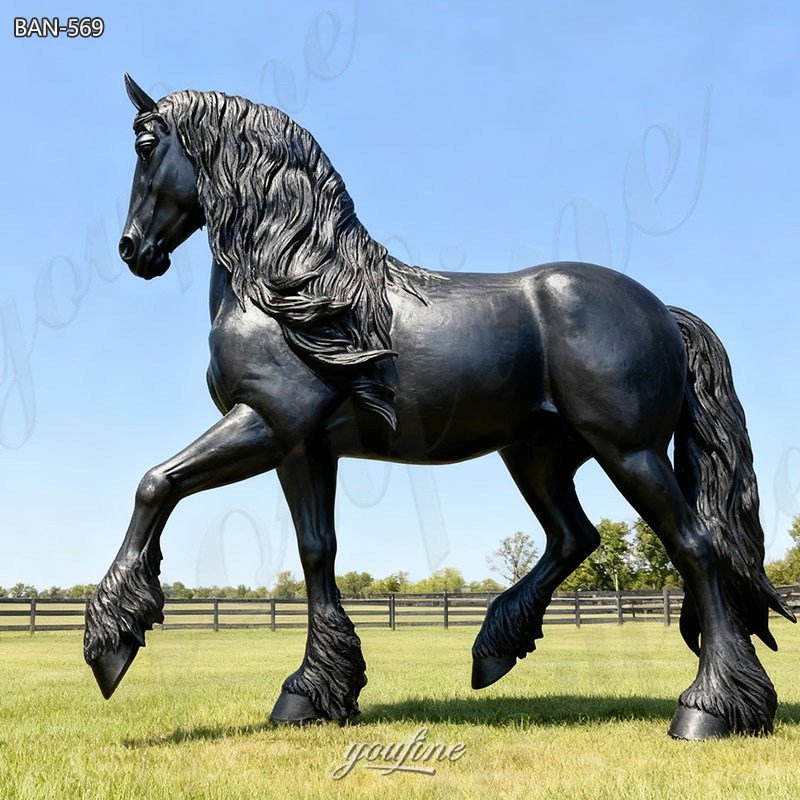
A life-size bronze horse may look completely finished when it leaves the foundry, but from a project point of view, there is still one important stage left: installation.
Over the years, we have worked with bronze horse statues for private estates, gardens, ranches, equestrian properties, resorts, entrances and public spaces. One thing we have learned is that a successful installation usually starts long before the wooden crate reaches the site.
The foundation needs to match the sculpture. The anchor points need to be confirmed. A crane or forklift needs enough access. The lifting team needs to know where the sculpture can safely carry weight.
None of these steps is especially complicated when they are planned in advance.
Problems usually appear when someone waits until the horse arrives to start asking these questions.
So, if you are preparing to install a life-size bronze horse statue outdoors, this is the project checklist we recommend following.
Before You Start: Confirm What You Are Actually Installing
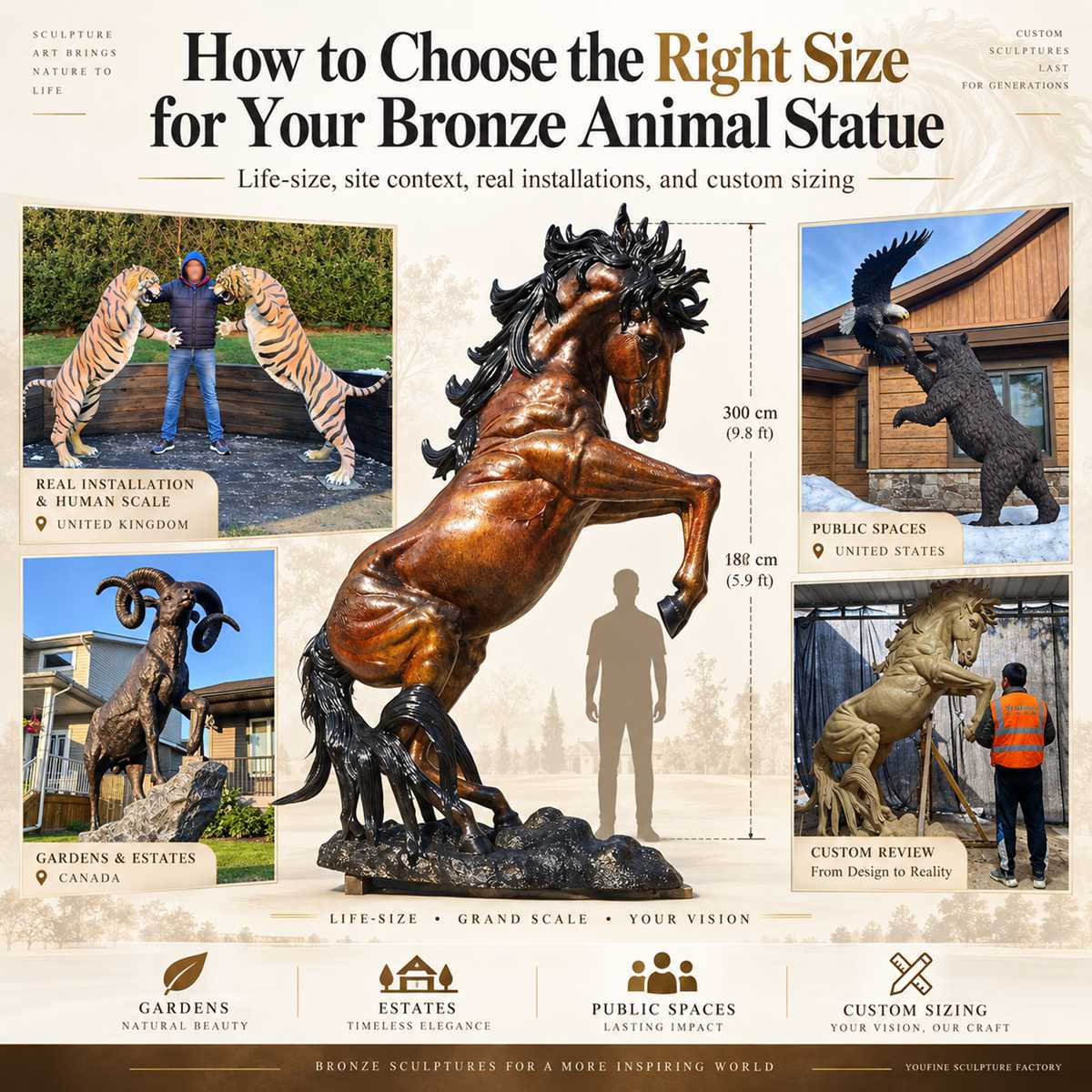
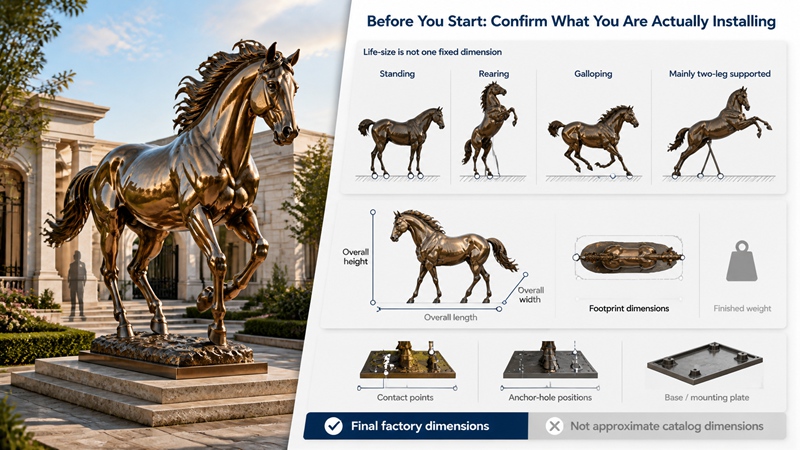
“Life-size” does not describe one fixed dimension.
Different horse breeds, poses and sculpture designs have different heights and footprints. A standing horse also creates very different structural conditions from a rearing horse, a galloping horse or a horse supported mainly by two legs.
Before preparing the site, confirm the actual finished sculpture dimensions rather than relying only on an early quotation or reference image.
You should have:
- overall height
- overall length
- overall width
- finished weight
- footprint dimensions
- number and position of contact points
- anchor-hole positions
- base or mounting plate dimensions
If you are still deciding what scale works best for your property, our Life-Size Bronze Animal Statue Size Guide for Gardens, Estates and Public Spaces explains how sculpture scale changes between gardens, estate entrances and larger public spaces.
Once production is finished, however, your contractor should work from the final factory dimensions, not approximate catalog dimensions.
Project Checklist for Installing a Bronze Horse Statue Outdoors
1. Check the Installation Site Before the Statue Ships
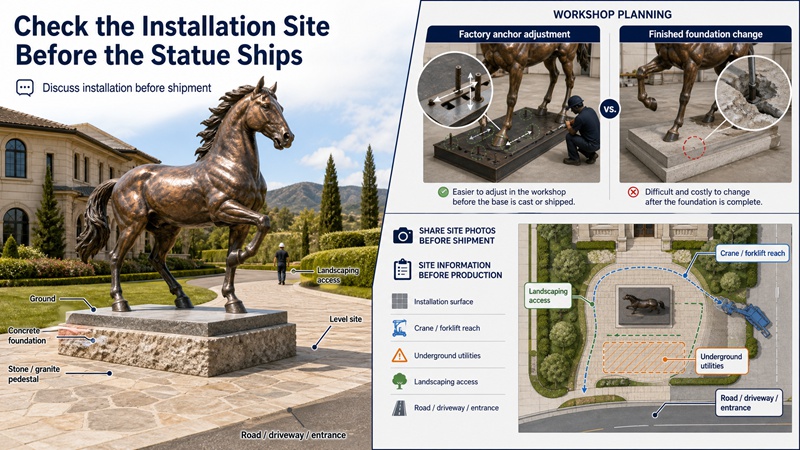
We prefer to discuss installation while the sculpture is still in our workshop.
Why?
Because changing an anchor position in the factory is much easier than changing a concrete foundation after a large bronze horse has already arrived on site.
Start by looking at the installation area.
Ask:
- Is the statue going directly onto the ground?
- Will it sit on a concrete foundation?
- Is there a stone or granite pedestal?
- Is the site level?
- Can a crane or forklift reach it?
- Are there underground utilities nearby?
- Will landscaping block equipment access?
- Is the sculpture close to a road, driveway or building entrance?
For estates and ranches, crane access is often relatively simple.
For landscaped gardens, completed resorts or public spaces, access can be more difficult because paving, trees, irrigation systems and finished planting may already surround the installation area.
This is why we recommend sharing site photos before shipment whenever possible.
If you are still at the planning and purchasing stage rather than the installation stage, our guide to custom bronze horse statue cost, timeline and design options explains why site information, pose and base design should ideally be confirmed before production begins.
2. Decide Whether You Need a Foundation or Pedestal
A large outdoor bronze horse should not simply be placed on soil or grass.
Even when the sculpture looks stable, wind, ground movement and accidental impact need to be considered.
Most permanent outdoor installations use one of three approaches:
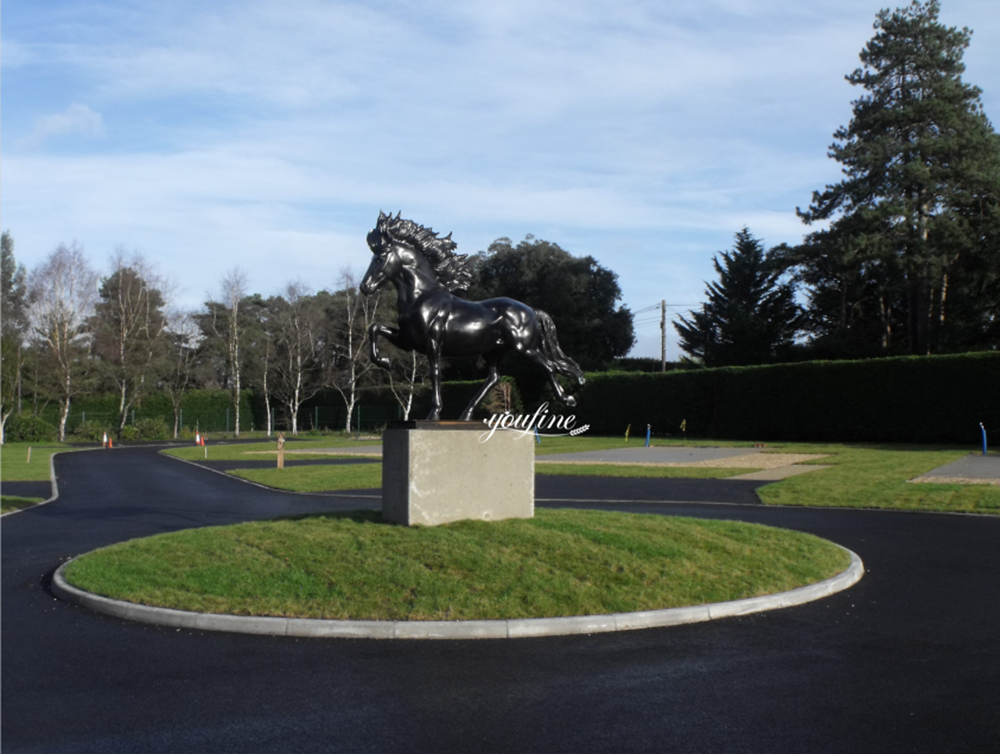
Concrete foundation
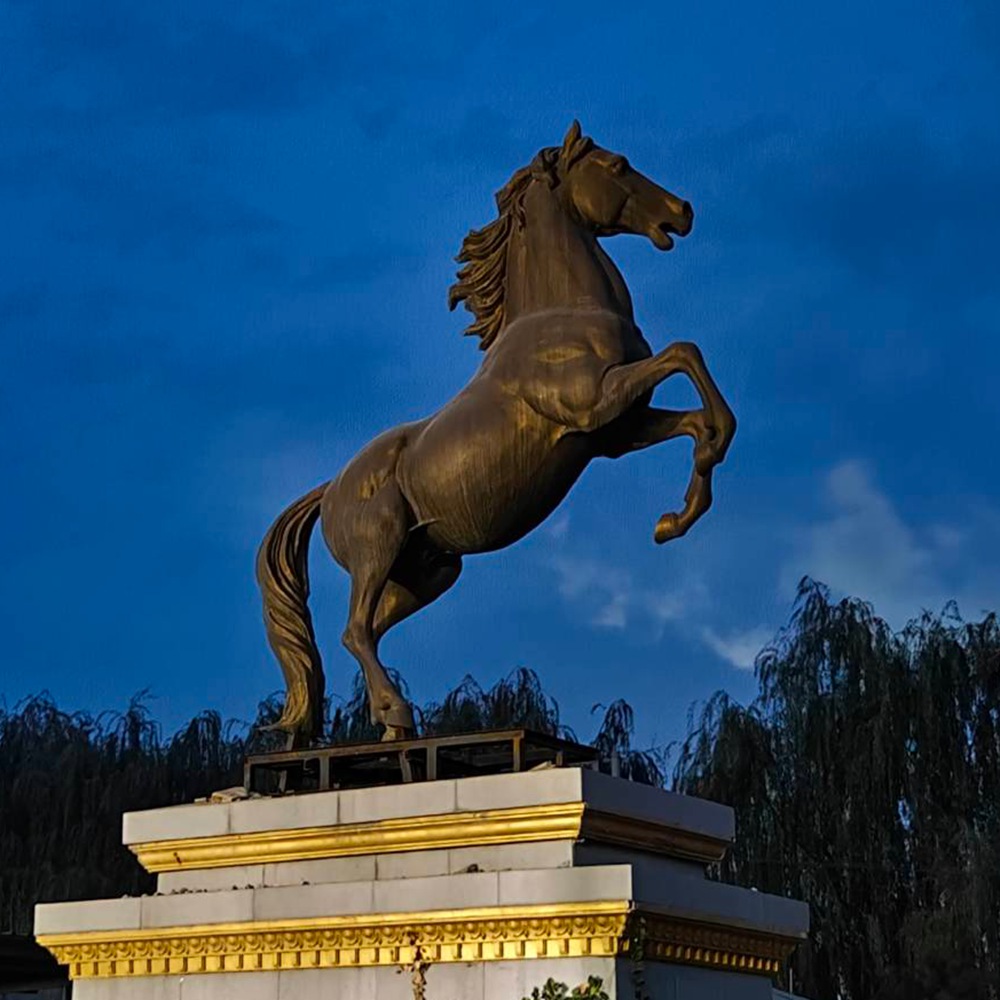
This is common for lawns, gardens, parks and open landscapes. The concrete remains largely below ground, so landscaping can visually hide the installation structure.
Concrete foundation with stone or granite pedestal
This works well for formal estate entrances, memorial projects, institutional spaces and architectural landscapes.
Structural mounting plate or engineered base
This may be used for larger public projects or unusual dynamic poses where engineering requirements are more complex.
The right solution depends on the horse’s size, weight, pose, soil conditions and local construction requirements.
For larger projects, we recommend having the foundation reviewed by a local structural engineer or contractor who understands the site conditions.
3. Confirm the Foundation Dimensions Before Pouring Concrete
This is one step we never recommend guessing.
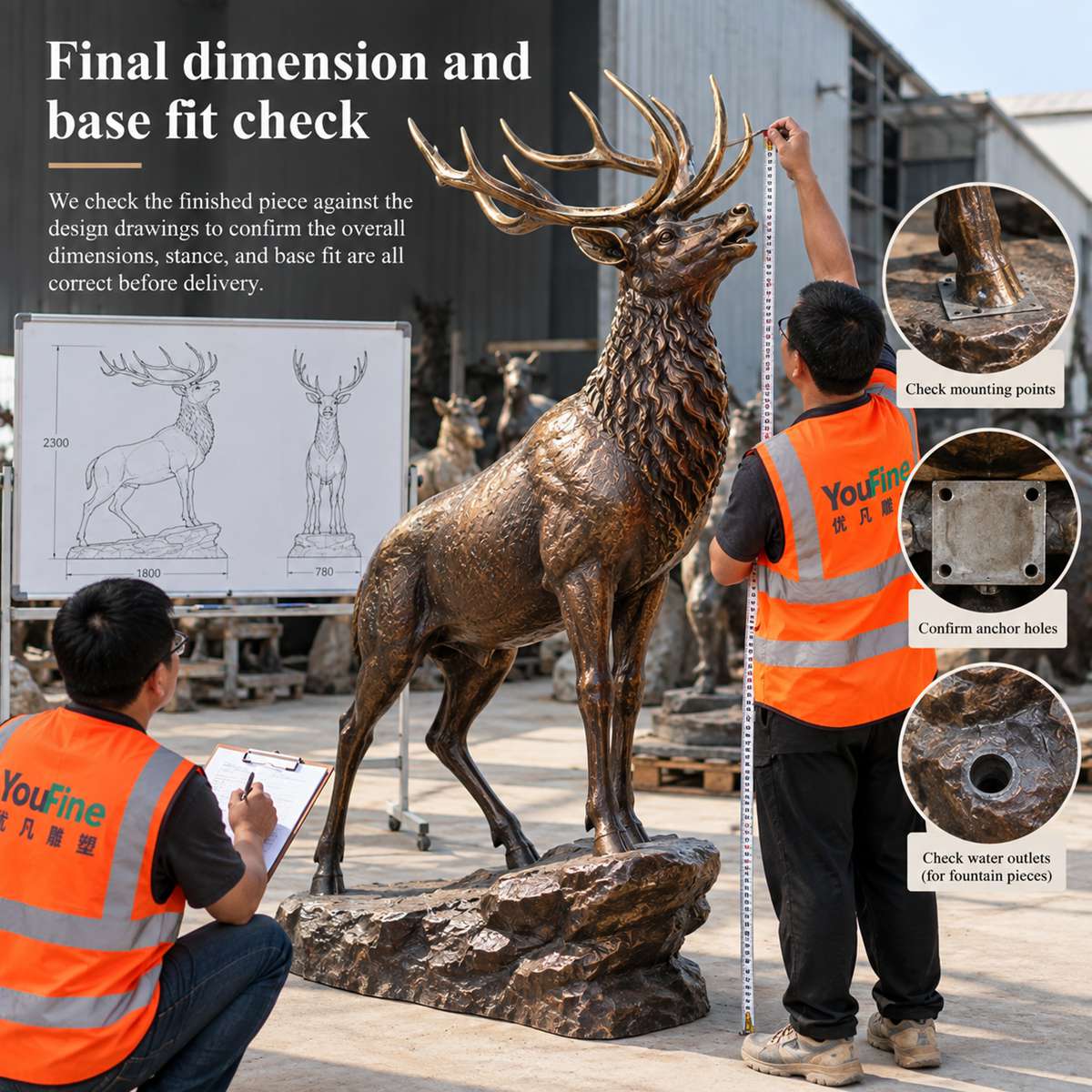
Before your contractor pours the foundation, compare the construction drawing with the final sculpture installation drawing.
Pay attention to:
- distance between horse legs
- exact anchor locations
- bolt diameter
- bolt spacing
- depth of the anchoring system
- pedestal dimensions
- finished ground level
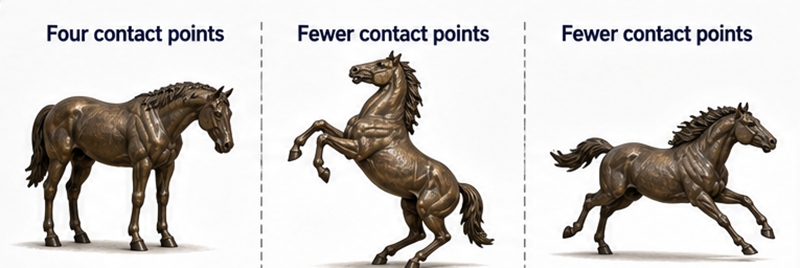
For a standing horse with four contact points, alignment may appear simple.
For a rearing or running horse, however, fewer contact points may carry much more structural load.
That changes how the statue should connect to its foundation.
A Useful Rule
Do not prepare permanent anchor holes from a product photograph.
Always use actual measurements or an installation drawing.
A difference of only a few centimeters can create an unnecessary headache once a heavy bronze sculpture is suspended above the foundation.
4. Plan Crane or Forklift Access Before Delivery Day
A life-size bronze horse is not something a few people can simply carry across a lawn.
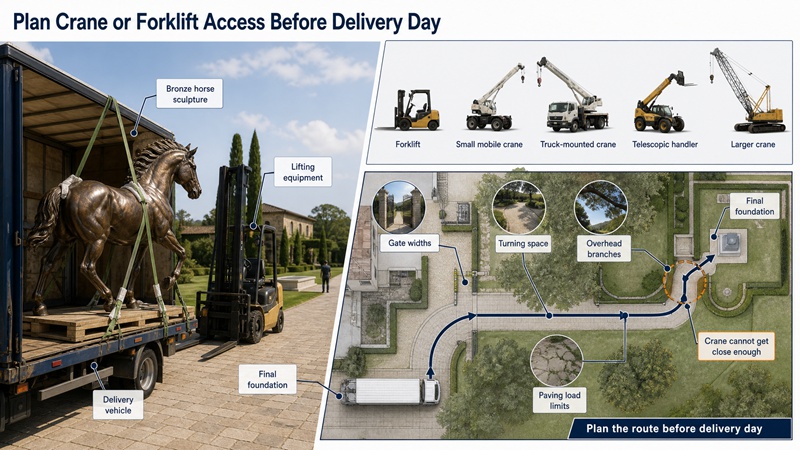
Depending on the size and design, lifting equipment may include:
- forklift
- small mobile crane
- truck-mounted crane
- telescopic handler
- larger crane for monumental sculptures
The equipment itself is only half of the question.
You also need to know whether it can actually reach the site.
Check gate widths, turning space, overhead branches, paving load limits and the distance between the delivery vehicle and the final foundation.
We recommend planning the route before delivery day.
It is surprisingly common for a beautiful installation site to have one awkward problem: the crane cannot get close enough to it.
5. Level the Sculpture Before Tightening the Anchors
Outdoor foundations are not always perfectly level.
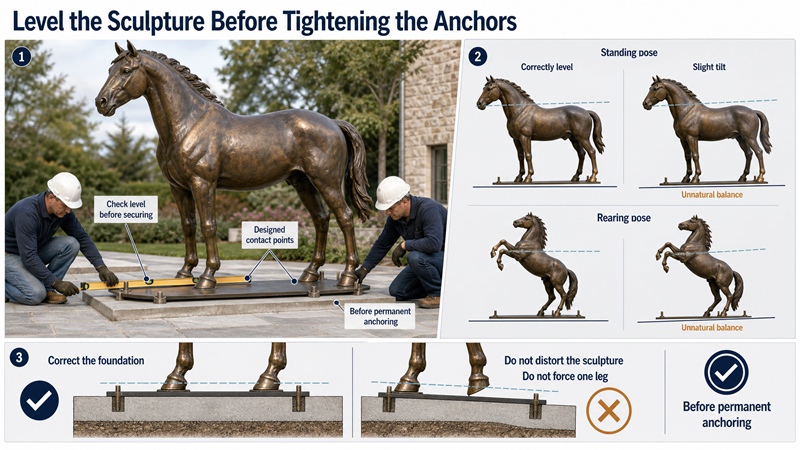
Before permanently securing the statue, check that the horse stands exactly as the sculptor intended.
A small tilt may make a standing horse look unnatural. On a dynamic rearing horse, it can change the entire sense of balance.
Use the designed contact points rather than trying to visually correct the sculpture by forcing one leg into a different position.
If the foundation needs adjustment, correct the foundation.
Do not distort the sculpture to compensate for it.
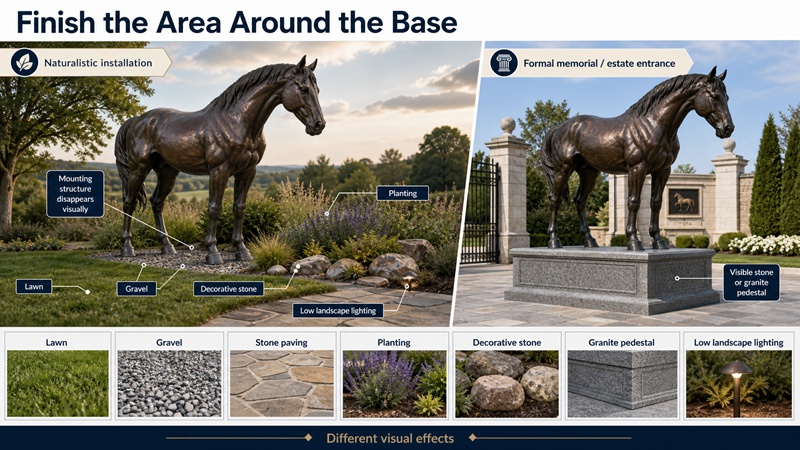
6. Finish the Area Around the Base
Once the statue is securely installed, the structural work does not have to remain visually obvious.
Depending on the landscape design, the foundation can often be integrated with:
- lawn
- gravel
- stone paving
- planting
- decorative stone
- granite pedestal
- low landscape lighting
For a naturalistic bronze horse installation, we often prefer the mounting structure to disappear visually.
The viewer should see a horse standing naturally in the landscape, not a complicated engineering system under its feet.
For memorials or formal estate entrances, however, a visible stone pedestal may become part of the design.
Both approaches work. They simply create very different visual effects.
What About Replacing or Installing a Bronze Horse on an Existing Pedestal?
Existing pedestals require additional measurement.
Do not assume that a new sculpture will fit simply because another statue stood there before.
We recommend checking:
- pedestal length and width
- usable mounting area
- existing holes
- internal reinforcement
- condition of the stone or concrete
- maximum load capacity
- access around the pedestal
If you send us clear photographs and dimensions, we can consider the pedestal while preparing the mounting arrangement.
For renovation projects, this can avoid unnecessary modification on site.
Frequently Asked Questions
How heavy is a life-size bronze horse statue?
There is no single standard weight. The final weight depends on the sculpture’s dimensions, pose, bronze thickness, internal reinforcement and base structure.
Always ask for the finished weight before arranging lifting equipment.
Can I install a bronze horse directly on grass?
For a permanent installation, we normally recommend a proper structural foundation below the landscape rather than placing the sculpture directly on soil.
Grass or planting can later cover the surrounding area so the foundation is barely visible.
Does every bronze horse need anchor bolts?
The mounting method depends on the sculpture design and site conditions, but large outdoor statues normally require a secure mechanical connection to their foundation or pedestal.
Can my local contractor install the sculpture?
Yes.
Many of our international projects use local contractors, crane operators and landscape teams for final installation.
Our role is to make sure they have the relevant dimensions and installation information before the sculpture arrives.
When should I start preparing the foundation?
You can plan the site early, but we recommend confirming final sculpture dimensions and mounting points before completing the permanent anchor arrangement.
This is particularly important for custom sculptures.
Does the horse need maintenance after installation?
Bronze works very well outdoors, but the surface will naturally interact with the environment over time.
Periodic cleaning and appropriate protective care help maintain the appearance of the patina, especially in coastal, humid or heavily landscaped environments.
A Good Installation Is Mostly Good Preparation
Installing a life-size bronze horse outdoors may look complicated when you first see the size of the sculpture and the shipping crate.
In practice, the process becomes much simpler when the important information is confirmed before delivery.
For every project, I would focus on five things first:
final dimensions, foundation, anchor points, lifting access and installation orientation.
Once these are clear, the rest of the installation becomes much easier to coordinate.
At YouFine, we do not want our involvement to end when a bronze horse leaves our workshop. For large outdoor projects, we can provide the dimensions, installation information, factory photos and technical details your local team needs to prepare the site.
If you are planning a bronze horse for an estate, ranch, equestrian facility, resort, garden or public landscape, send us a few photos of your installation area together with the approximate size you are considering.
We can help you think through the project before production begins, so the sculpture arrives ready for the place where it will actually live.