Every week, I speak with buyers who arrive at the same question: “How much does a custom bronze horse statue cost, and how long will it take?” It is a fair question, and I want to give you a genuinely useful answer — not a placeholder range that tells you nothing, and not a low-price promise that disappears once production starts.
The honest answer is that the cost and timeline for a custom bronze horse statue depend on choices you have not yet made. The purpose of this article is to help you make those choices clearly, prepare a complete inquiry, and move forward with confidence rather than guesswork.
What Actually Drives the Cost of a Custom Bronze Horse Statue
Many buyers assume that statue height is the main cost factor. Height matters, but it is one variable among several. The following table shows the full range of cost drivers I look at when preparing a custom quotation.
| Cost Factor | What It Covers | Why It Affects Price |
|---|---|---|
| Size and scale | Overall height, body length, base dimensions | Larger statues require more bronze, more labor, and heavier packaging |
| Pose complexity | Standing, rearing, galloping, grazing, multi-horse group | Dynamic poses with raised legs need internal steel armatures and more structural engineering1 |
| Anatomical detail level | Musculature, coat texture, mane movement, facial expression | Higher detail requires more clay modeling hours and more hand-chasing after casting |
| Real horse portrait vs. decorative design | Based on a specific animal or a general breed type | Portrait work requires more reference study, more revision cycles, and closer approval |
| Casting method and bronze quality | Lost-wax casting vs. sand casting; bronze alloy grade | Lost-wax casting captures finer detail but involves more labor per piece2 |
| Surface finish and patina | Natural brown, antique green, custom color blend | Multi-tone or custom patina effects require additional chemical treatment and hand finishing |
| Base or pedestal | Stone, granite, cast bronze, or no base | Custom stone bases or inscribed pedestals add design and material cost |
| Packaging and shipping scope | Crating, sea freight, customs documentation | Large or heavy statues require engineered wooden crates and specialist freight |
The practical takeaway: two statues that appear similar in a photo can differ significantly in cost because of pose, base, finish, and portrait requirements. That is why I cannot offer an accurate quotation without dimensions, reference images, site information, and a description of what the statue is meant to do.

Understanding the Timeline as a Series of Stages
A custom bronze horse statue is not a product pulled from inventory. It moves through a sequence of stages, and the total timeline depends as much on how quickly you approve each stage as on how fast the workshop produces it.
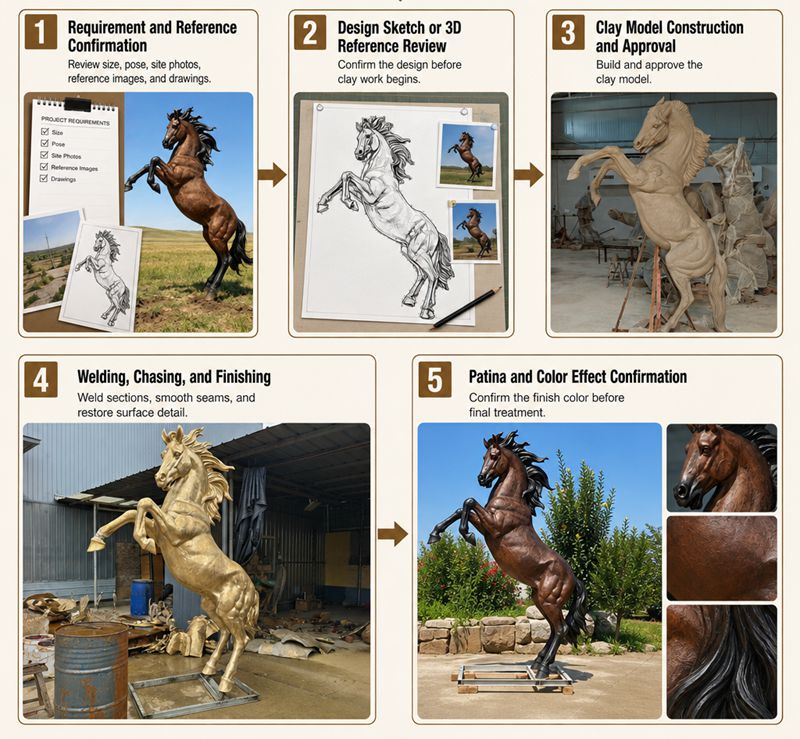
Here is a realistic view of the process:
- Requirement and reference confirmation — I review your size, pose, site photos, reference images, and any drawings. Incomplete references slow everything down at this point.
- Design sketch or 3D reference review — For complex or portrait-based statues, a reference drawing or digital model may be prepared before clay work begins.
- Clay model construction and approval — A full-scale or scaled clay model is built by the sculptors. This is the most important checkpoint. Changes made here cost far less than changes made to a finished bronze.
- Bronze casting — The approved clay model is used to produce wax patterns, which are then invested in ceramic shell and cast in bronze3. This stage cannot be rushed without compromising quality.
- Welding, chasing, and finishing — Cast sections are welded together, seams are ground smooth, and surface texture is hand-chased4 to restore detail lost in casting.
- Patina and color effect confirmation — A sample area or test piece is finished to confirm the color before the full statue is treated. This is the second critical visual checkpoint.
- Final inspection, packing, and dispatch — The finished statue is inspected, photographed, and packed into a custom engineered crate for shipping.
Delays I see most often come from customers who cannot confirm reference materials quickly, request design changes after clay modeling begins, or take several weeks to approve the clay model photos. Clear communication at each checkpoint protects your deadline.
Can You Replicate My Real Horse?
This is one of the most common questions I receive, and I want to answer it carefully.
Yes — a specific horse can be used as the design basis for a custom bronze portrait statue. However, the accuracy of that portrait depends entirely on the quality and volume of reference material you provide.
Useful references for a horse portrait include: photographs from multiple angles (front, both sides, rear, three-quarter views), videos showing movement and natural posture, written descriptions of distinctive markings, measurements of body height and key proportions, and any existing artwork or previous photos from different life stages.
What I want to be clear about: a handful of casual smartphone photos will not give the sculptors enough information to produce a precise likeness5. The more complete your reference package, the closer the final statue will match your expectations. If your references are limited, I will tell you that upfront rather than overpromise and underdeliver.
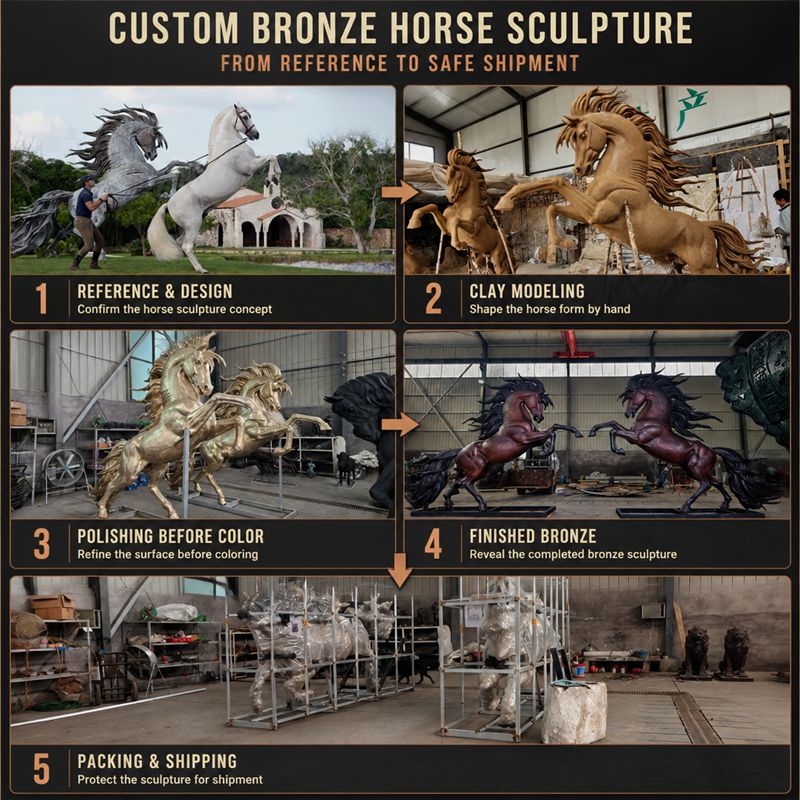
If you are interested in how a life-size bronze horse statue is physically produced from reference to finished casting, I have written a detailed step-by-step explanation in how to make a life-size bronze horse statue that covers the full production method.
Design Options and How to Connect Them to Your Site
Before selecting a pose or style, I always ask: what is this statue meant to do for the space?
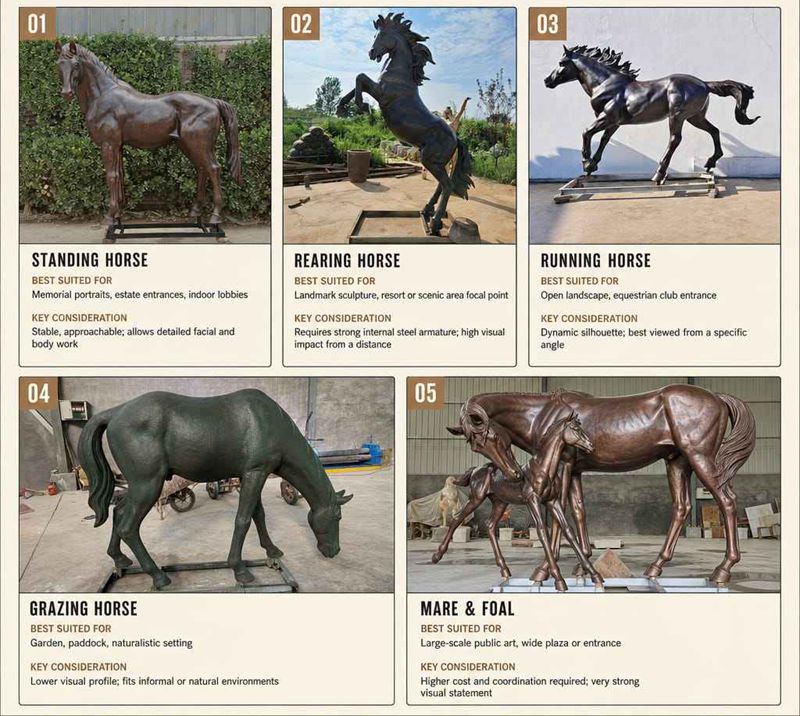
| Design Choice | Best Suited For | Key Consideration |
|---|---|---|
| Standing or walking pose | Memorial portraits, estate entrances, indoor lobbies | Stable, approachable; allows detailed facial and body work |
| Rearing pose | Landmark sculpture, resort or scenic area focal point | Requires strong internal steel armature; high visual impact from a distance |
| Galloping or running pose | Open landscape, equestrian club entrance | Dynamic silhouette; best viewed from a specific angle |
| Grazing pose | Garden, paddock, naturalistic setting | Lower visual profile; fits informal or natural environments |
| Multi-horse group | Large-scale public art, wide plaza or entrance | Higher cost and coordination required; very strong visual statement |
| Stylized or artistic interpretation | Contemporary resort, architectural project | More creative freedom; less dependent on anatomical precision |
| Realistic portrait style | Memorial, private commission, breed commemoration | Highest reference and approval demands; most personal result |
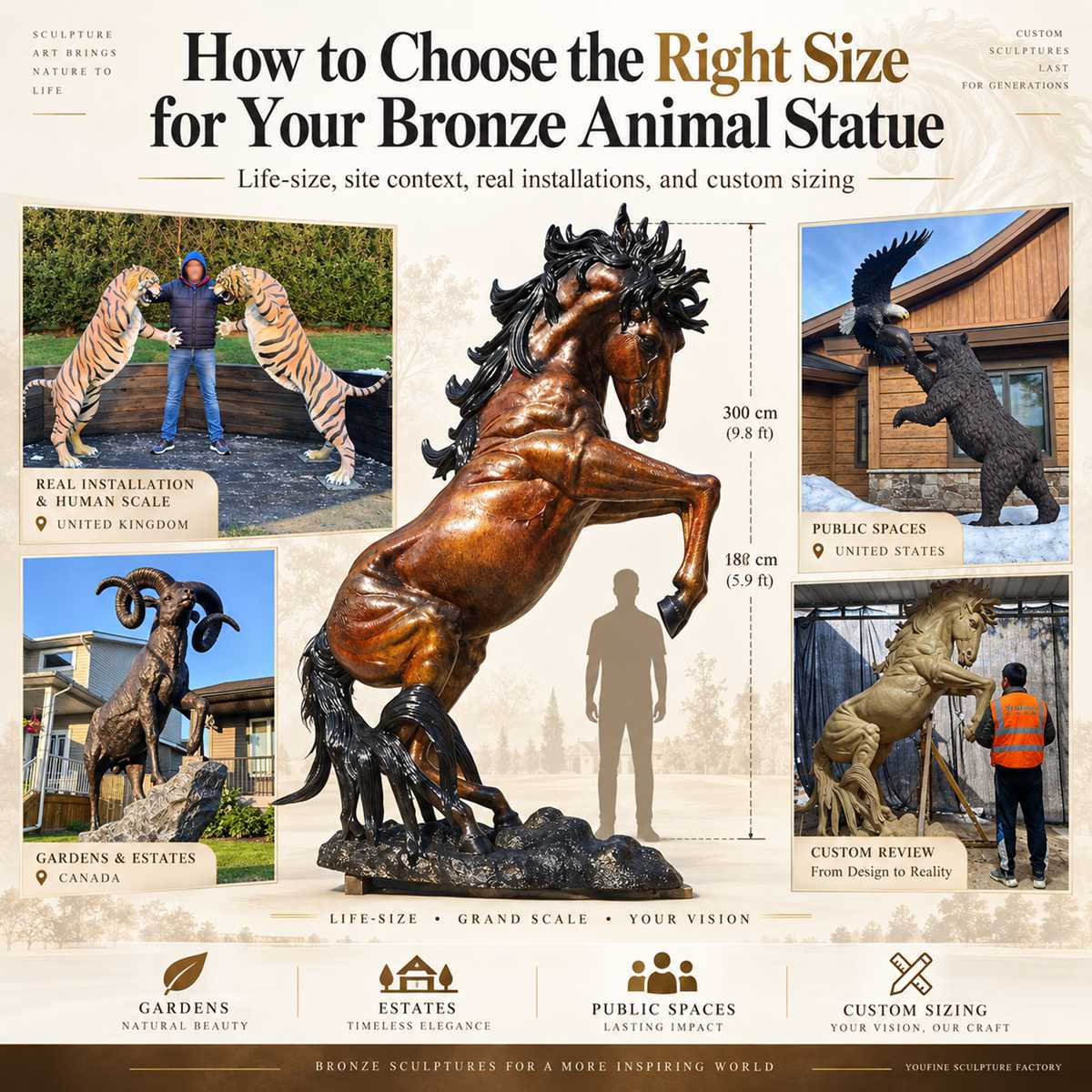
An entrance landmark for a resort or equestrian facility typically benefits from a rearing or galloping pose at an enlarged scale, because the statue needs to read clearly from a moving vehicle or from 50 meters away. A memorial horse statue for a private estate, by contrast, gains more from close-range emotional accuracy — facial expression, body markings, and posture that people who knew the horse will recognize.
If you are exploring what different horse poses symbolize before making a decision, this article on bronze horse statue meaning and symbolism may help you connect cultural meaning to your design choice. There is also a specific explanation of the meaning of a bronze horse statue with two legs raised if a rearing pose is under consideration.
Why Supplier Quotations Vary So Much
If you have already contacted several suppliers and received quotations that differ by 40% or more, this is normal — and it does not mean that the lowest quote is the best value.
Different suppliers may quote different scopes. One quote may include clay modeling and all approval rounds. Another may price only the casting, leaving modeling, patina, base, and shipping as separate items that appear later. Some suppliers use thinner bronze walls, simpler casting methods, or skip the clay approval stage entirely.
When comparing quotations, I recommend asking each supplier to confirm what is included. Specifically ask about: clay model preparation and approval, bronze wall thickness, casting method, surface finishing process, patina color options, base or pedestal design, packing specification, and freight scope.
A complete, transparent quotation is a better basis for comparison than the final number alone. If you want guidance on evaluating quality before you commit, how to choose a high-quality bronze horse yard statue covers the practical quality indicators worth checking.

Three Approval Checkpoints That Protect Your Project
Before full bronze production begins, I recommend insisting on three formal approval points with any supplier:
- Reference material confirmation — Both parties agree on the exact references, dimensions, pose, and finish direction before any modeling work begins. Changes after this point affect cost and timeline.
- Clay model or scaled model approval — You review photographs or a physical model before casting. This is your most powerful opportunity to catch proportional or expressive issues at low cost.
- Patina and color effect confirmation — A finished color test is approved on a sample area before the full statue is treated. Surface color is difficult to reverse after application.
These three checkpoints do not slow a project down. They prevent the much larger delays and costs that come from discovering a problem after the bronze has been poured.

How to Prepare a Strong Horse Statue Inquiry
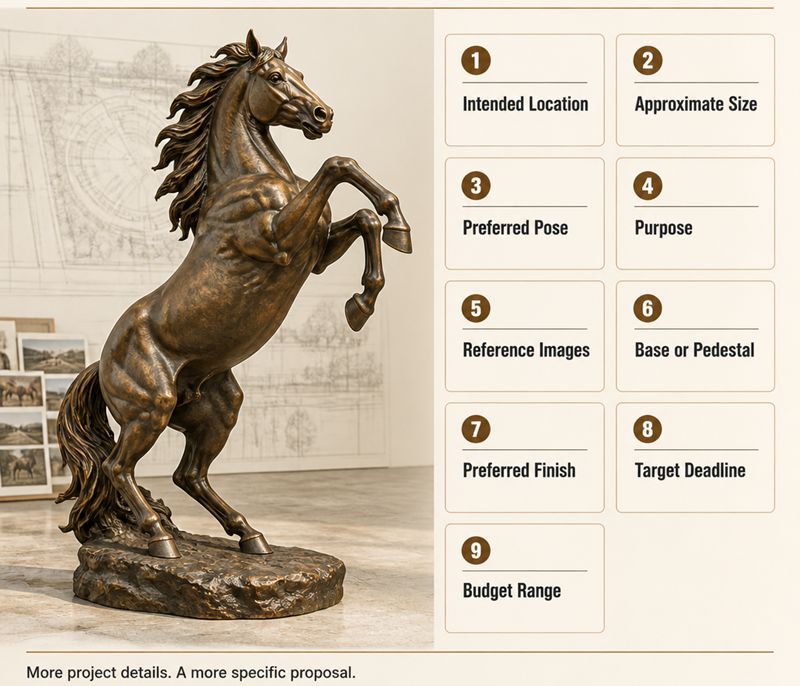
The most effective inquiry I receive contains:
- Intended location (country, site type — estate, resort, equestrian facility, public plaza)
- Approximate size (overall height or body length you have in mind)
- Preferred pose (standing, rearing, galloping, grazing, or open to recommendation)
- Purpose (landmark, memorial, cultural expression, landscape decoration)
- Reference images (photos of the space, photos of the horse if portrait-based, style references)
- Base or pedestal preference (stone, bronze, concrete plinth, or none)
- Preferred finish (natural bronze patina, antique green, custom color, or open)
- Target deadline (installation date or project handover date)
- Budget range if known (even a general range helps prioritize options)
You do not need to have all of these answers finalized to start a conversation. But the more complete your initial brief, the more specific and useful my initial proposal can be.
Frequently Asked Questions
1. How long does a custom bronze horse statue typically take to produce?
The timeline varies by size, complexity, and how quickly approvals move. A life-size bronze horse with a standard pose and one or two approval rounds can typically take between 60 and 90 days after all references are confirmed. Larger, more complex pieces with portrait requirements or multi-horse compositions take longer. Rushing production after casting has begun is not possible without compromising quality, so setting a realistic deadline from the start is important.
2. Is it possible to get an accurate price without finalizing the design?
An initial estimate is possible with approximate dimensions and pose direction, but it should be treated as a planning reference rather than a firm quotation. Accurate pricing requires confirmed dimensions, pose, reference images, finish choice, base specification, and shipping destination. Requesting a firm quote too early often leads to surprises later when design decisions are finalized.
3. What is the difference between lost-wax casting and sand casting for bronze horse statues?
Lost-wax casting (also called investment casting) produces finer surface detail and better reproduces the sculptor’s original clay texture6. It is the preferred method for detailed portrait statues and complex poses. Sand casting is faster and lower in cost but captures less fine detail7. For high-value outdoor landmark or portrait statues, lost-wax casting is generally the appropriate choice.
4. Can I request a specific bronze color other than traditional brown or green?
Yes. Surface patina is applied chemically and by hand after casting, and the color can be adjusted based on a sample approval. Common options include traditional warm brown, antique green (verdigris), dark charcoal, golden bronze, and multi-tone blended effects. The patina approval stage allows you to confirm the exact color before it is applied to the full statue.
5. What happens if the finished statue looks different from what I expected?
This risk is significantly reduced when all three approval checkpoints are used correctly. If the reference material is confirmed in writing, the clay model is approved before casting, and the patina color is approved on a sample, there is very little room for unexpected visual deviation. Most disappointments I have seen come from projects where one or more of these checkpoints was skipped or rushed.
6. Can bronze horse statues be installed outdoors permanently, and what maintenance do they need?
Bronze is one of the most durable materials for permanent outdoor installation. It handles temperature variation, UV exposure, rain, and coastal air well. Periodic cleaning and the application of a protective wax coating once or twice a year will maintain the surface appearance and slow natural weathering. If you are considering a home or garden setting, this guide on keeping a horse statue at home and where to place a horse statue at home cover placement and care in more detail.

Summary
A custom bronze horse statue is a long-term investment in a space and in a story. The decisions that determine quality and cost — pose, size, detail level, portrait requirements, finish, base, and shipping — need to be made clearly before production begins, not discovered mid-project.
The strongest approach is to prepare a detailed inquiry brief, insist on the three key approval checkpoints, and compare supplier quotations by scope rather than by final number alone. That process will protect both your budget and your final result.
If you are ready to move from interest to a reliable initial proposal, I invite you to share your project location, intended size, site photos, preferred pose, reference images, and target deadline. With that information, I can prepare a specific custom plan that reflects what your project actually requires.
Contact You Fine Art Sculpture to start your inquiry — and get a proposal built around your project, not a generic price list.
- Guidelines for the Technical Examination of Bronze Sculpture ↩︎
- Lost Wax Casting vs Sand Casting Process Advantages Compared ↩︎
- Lost-wax casting – Wikipedia ↩︎
- The Sculpture Process | Weishel ↩︎
- How to Create a Portrait in Sculpture: A Step-by-Step Guide ↩︎
- Choosing A Bronze Casting Method: Lost-Wax Vs Sand ↩︎
- Investment Casting vs. Sand Casting – Which One to Choose? ↩︎