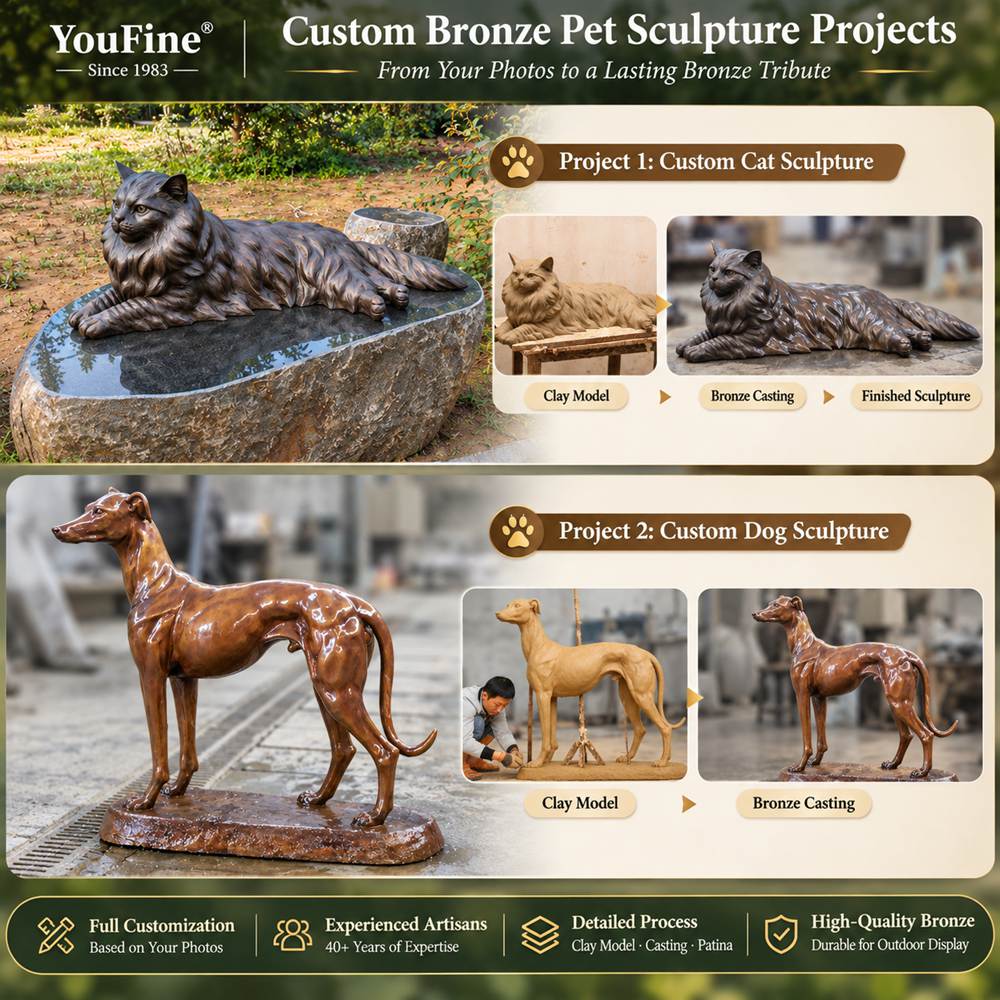
From my experience with customer communication and pre-quotation consultation at You Fine Art Sculpture, I have learned that the most useful pet photographs are not always the most beautiful ones. A favorite picture may capture your pet’s personality perfectly while leaving the shape of the muzzle, the body proportions, or the position of the ears unclear.
For a custom bronze pet statue, I recommend complementary photographs that show the face, both sides of the body, and distinctive features, together with a clear choice of life stage and pose. Full-body photographs explain proportions; close-ups help clarify facial structure. Additional angles can resolve details that one photograph cannot show.
This is a practical checklist, not a fixed photo requirement. Sending more images does not automatically make the reference clearer, and submitting photographs is not the same as approving likeness. My initial review helps identify useful references and unanswered questions. Facial details and identifying features still need your confirmation during modeling.
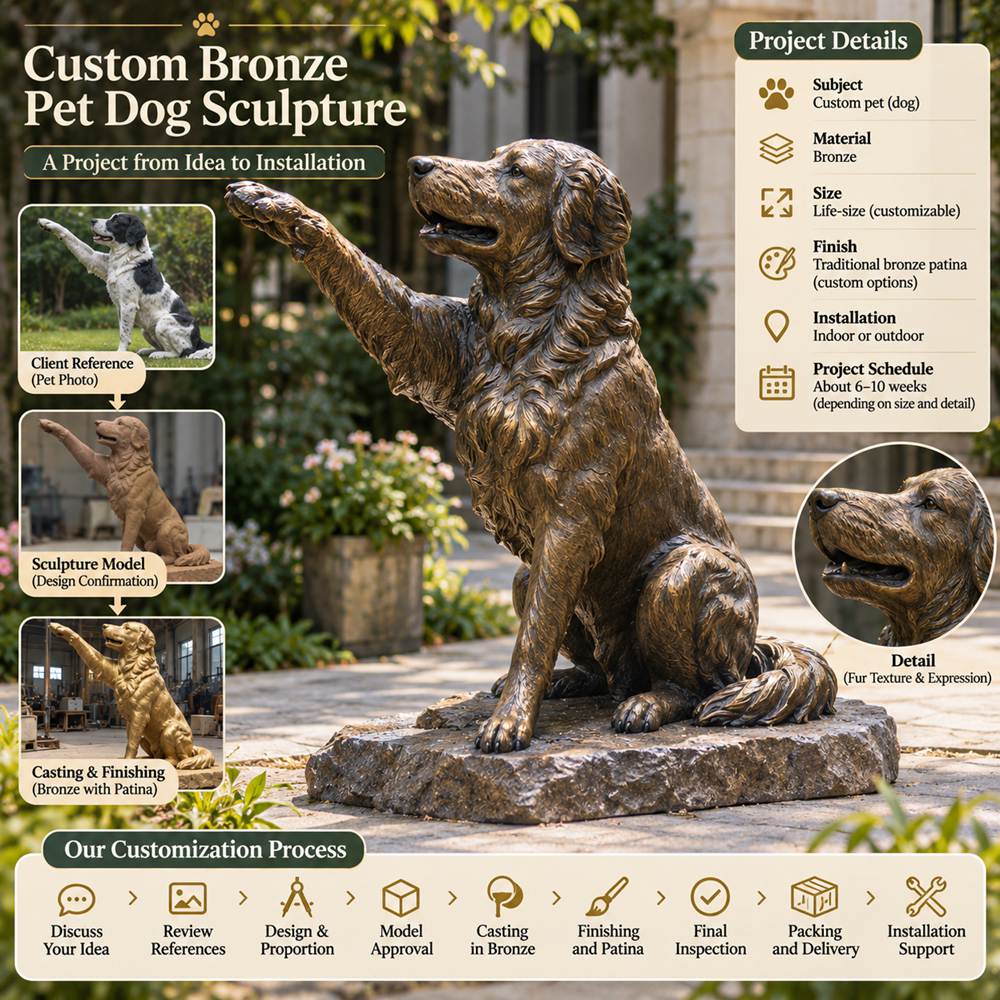
Which Photo Angles Are Most Helpful?
When I assess reference materials for an initial consultation, I look at what each image contributes. Several photographs showing nearly the same angle may provide less useful information than a smaller, varied selection.
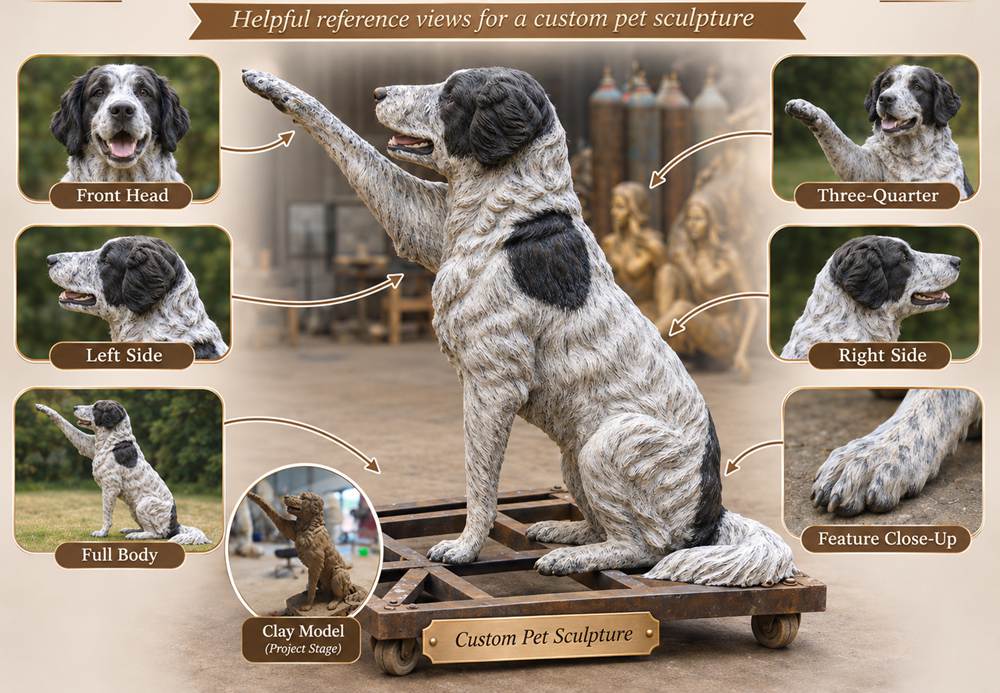
I suggest checking your available photographs against these views.
| Reference View | What It Helps Explain | What to Check |
|---|---|---|
| Front-facing head view | Face width, eye spacing, muzzle shape, and ear placement | The face should be visible without strong shadows or an extreme head tilt |
| Left-side view | Head profile, neck shape, body length, and stance | Look for a clear outline rather than a partly hidden body |
| Right-side view | Features or proportions not visible from the left | Note differences in ears, scars, or other identifying details |
| Three-quarter view | How the front and side forms connect | Choose an image that shows the muzzle, cheek, and head depth clearly |
| Full-body view | Leg length, chest depth, overall proportions, and posture | Include the feet and tail where possible |
| Feature close-up | Ear shape, nose, paws, tail, or another distinctive detail | Explain which feature you want the image to clarify |
These views help explain three-dimensional form—the pet’s shape from different directions. I do not treat the table as a mandatory submission standard. If you lack a particular angle, send what you have and identify the gap.
Why One Front Photo Is Usually Not Enough
A clear front view can be valuable, but it does not fully explain how far the muzzle projects, how the back of the head curves, or how the chest connects to the body.
I also watch for perspective distortion: changes in apparent proportions caused by the camera position. A close photograph taken above the pet may make the head look larger and the legs shorter. That does not make the image useless, but it may be better as a facial reference than as evidence of body proportions.
If you are taking new photographs, I suggest photographing near the pet’s level, keeping the camera reasonably straight, and avoiding very close wide-angle shots. There is no need to force an uncomfortable pose simply to complete the checklist.
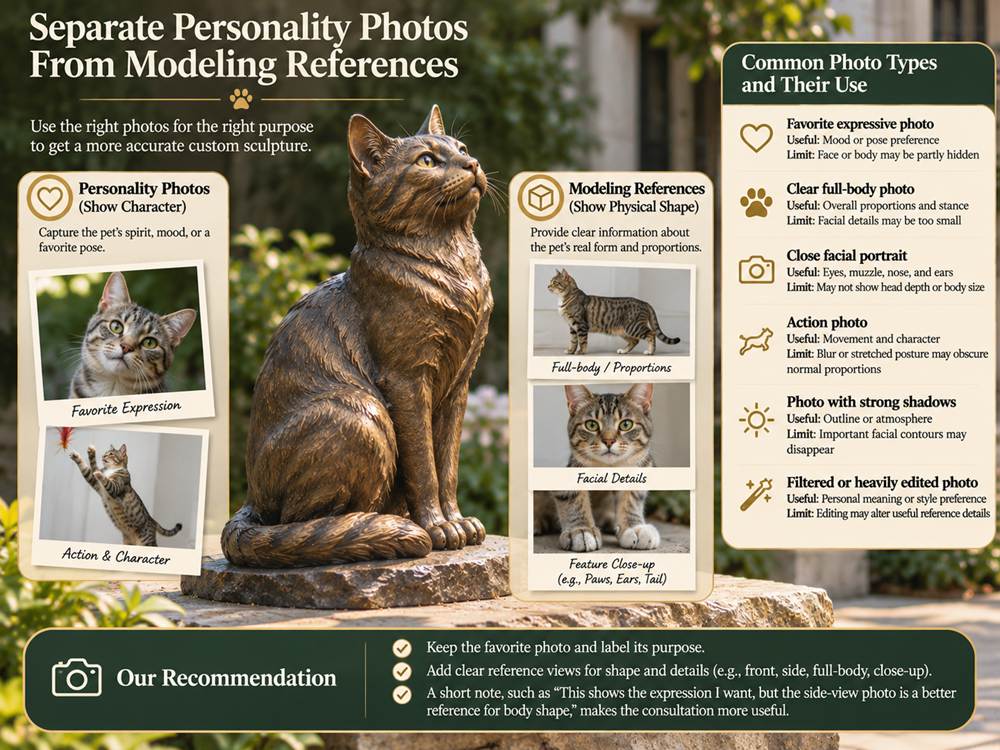
Separate Personality Photos From Modeling References
I understand why owners begin with a favorite photograph. An alert expression, a familiar head tilt, or a relaxed sitting position can communicate what made the pet special.
However, I separate two questions:
- What does this image tell me about the pet’s personality?
- What does it reliably show about the pet’s physical shape?
One photograph can answer both, but it does not always do so.
I use the following distinctions when explaining why an appealing image may need supporting references.
| Photo Type | Useful Contribution | Possible Limitation |
|---|---|---|
| Favorite expressive photo | Mood, head tilt, or pose preference | The face or body may be partly hidden |
| Clear full-body photo | Overall proportions and stance | Facial details may be too small to assess |
| Close facial portrait | Eyes, muzzle, nose, and ear details | It may not explain head depth or body size |
| Action photo | Movement and character | Blur or stretched posture may obscure normal proportions |
| Photo with strong shadows | Outline or atmosphere | Important facial contours may disappear |
| Filtered or heavily edited photo | Personal meaning or appearance preference | Editing may alter useful reference details |
My recommendation is to keep the favorite image and label its purpose. For example: “This shows the expression I want, but the side-view photograph is a better reference for body shape.”
That short explanation makes the consultation more useful than sending a large, unorganized collection.
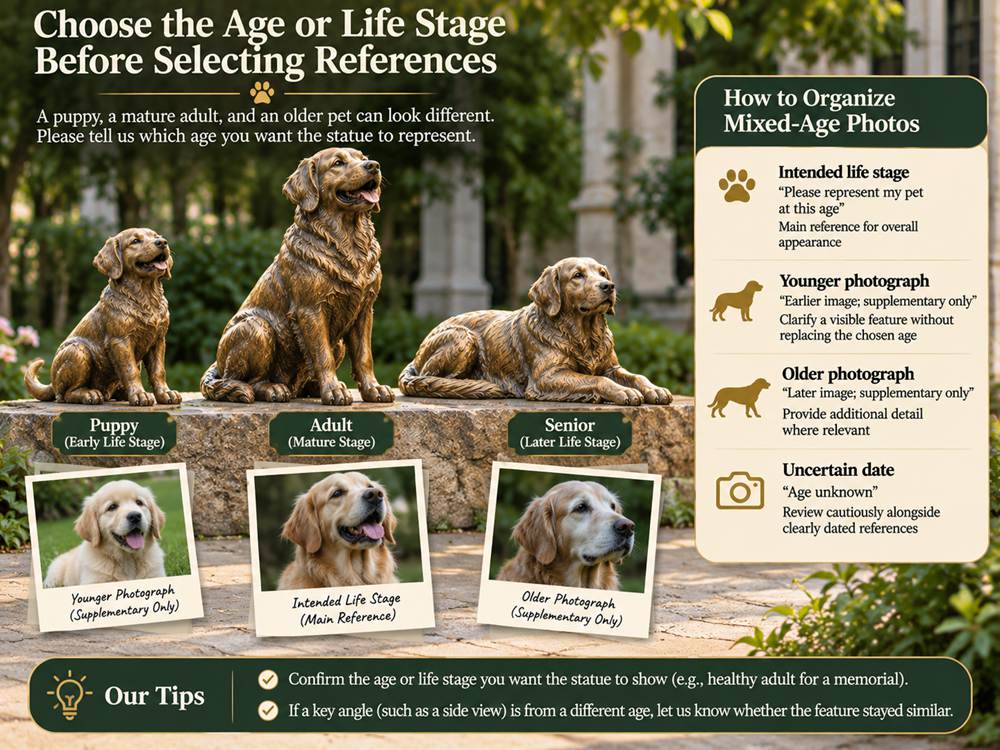
Choose the Age or Life Stage Before Selecting References
One of the first points I want clarified is which age the statue should represent.
A puppy or kitten, a mature adult, and an older pet may have different proportions, posture, and facial appearance. Photographs from different ages should not be treated as interchangeable.
I suggest organizing mixed-age photographs this way.
| Reference Role | How to Label It | How It Should Be Used |
|---|---|---|
| Intended life stage | “Please represent my pet at this age” | Main reference for overall appearance |
| Younger photograph | “Earlier image; supplementary only” | Clarify a visible feature without replacing the chosen age |
| Older photograph | “Later image; supplementary only” | Provide additional detail where relevant |
| Uncertain date | “Age unknown” | Review cautiously alongside clearly dated references |
If the clearest side view is from an earlier age, it may still provide useful information. I would want to know whether the feature shown remained similar at the age you want represented.
For a memorial statue, you might prefer a healthy adult appearance rather than the pet’s final life stage. Please state that preference directly; I should not infer it from whichever image is sharpest.
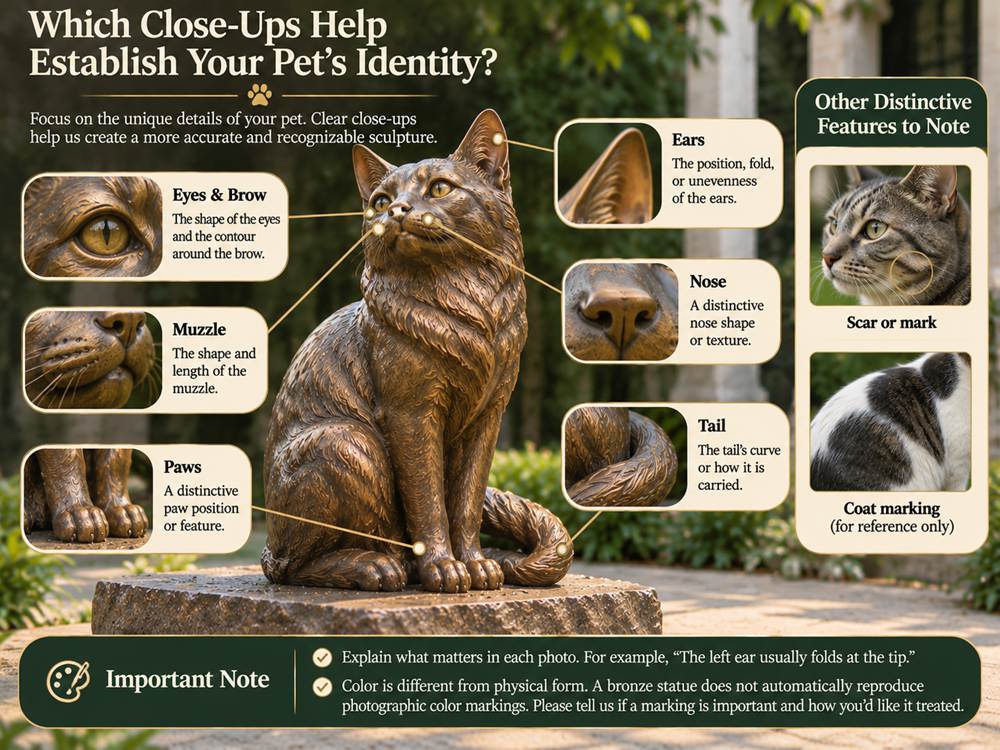
Which Close-Ups Help Establish Your Pet’s Identity?
Breed alone does not explain an individual pet’s appearance. I encourage you to identify the details you notice first when looking at your pet.
Useful close-ups may show:
- The shape and length of the muzzle.
- The position, fold, or unevenness of the ears.
- The contour around the eyes and brow.
- A distinctive nose shape.
- The tail’s curve or how it is carried.
- An unusual paw position, scar, or other visible feature.
Please explain what matters in each image. “The left ear usually folds at the tip” is more actionable than “Make the ears correct.”
I also distinguish color from physical form. A coat marking may be highly recognizable in a photograph, but a bronze sculpture does not automatically reproduce photographic color differences. If a marking is important to recognition, I recommend raising it during consultation so its intended treatment can be clarified rather than assumed.
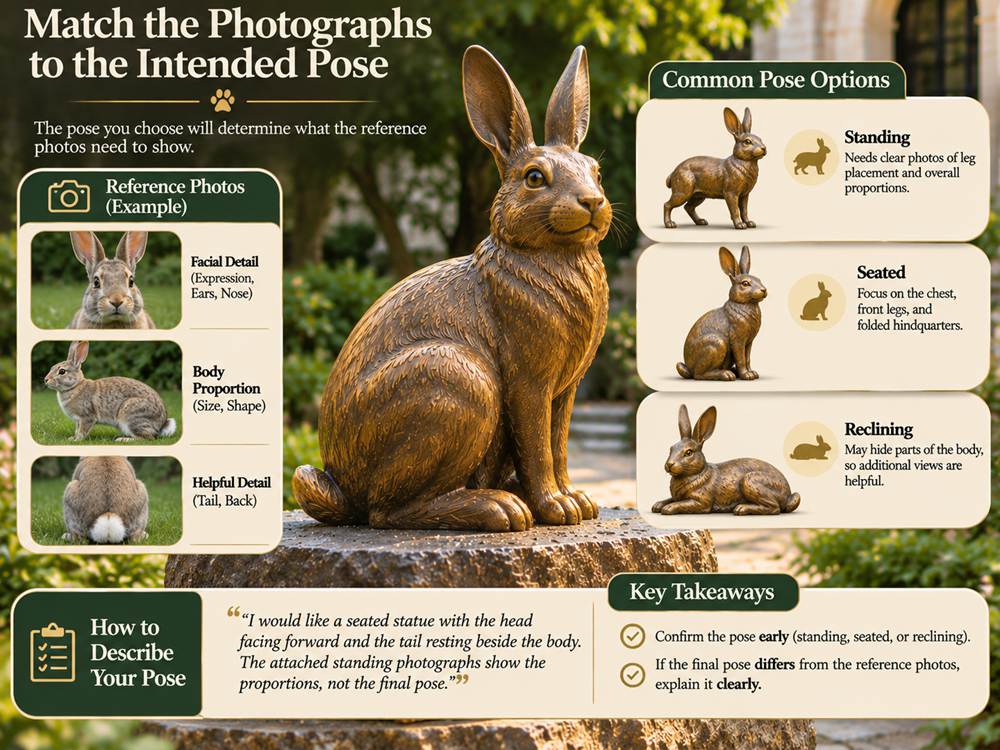
Match the Photographs to the Intended Pose
I ask about pose early because it changes what the reference photographs need to explain.
A standing statue requires a clear understanding of leg placement and body proportions. A seated statue needs attention to the chest, front legs, and folded hindquarters. A reclining pose may hide parts of the body, making additional views helpful.
Your preferred photograph does not have to show the exact final pose. However, if the requested pose differs from the references, that difference should be discussed explicitly.
I recommend describing the pose in ordinary language:“I would like a seated statue with the head facing forward and the tail resting beside the body. The attached standing photographs show the proportions, not the final pose.”
That statement separates appearance references from pose instructions and makes potential uncertainties easier to identify.
What If You Cannot Take More Photographs?
If your pet has passed away, or additional photography is otherwise impossible, I recommend beginning with the existing images. You do not need to delay the inquiry simply because the collection is incomplete.
Select the photographs that best represent the intended appearance and tell me which details are missing or uncertain. Useful steps include:
- Check original files where available. A full-resolution image may reveal more than a screenshot or compressed copy.
- Look through family photographs. A less polished image may show a useful profile, tail, or body outline.
- Identify the strongest reference. Tell me which photograph feels most representative of your pet.
- Add brief written observations. Describe distinctive features not clearly visible in the images.
- Be open about uncertainty. If you cannot remember a detail confidently, say so.
Written descriptions can guide questions, but they do not replace every missing visual reference. I cannot assume that every incomplete photo set supports the same level of detail or confidence.
The purpose of consultation is to establish what the available materials explain, what remains ambiguous, and what needs further discussion.
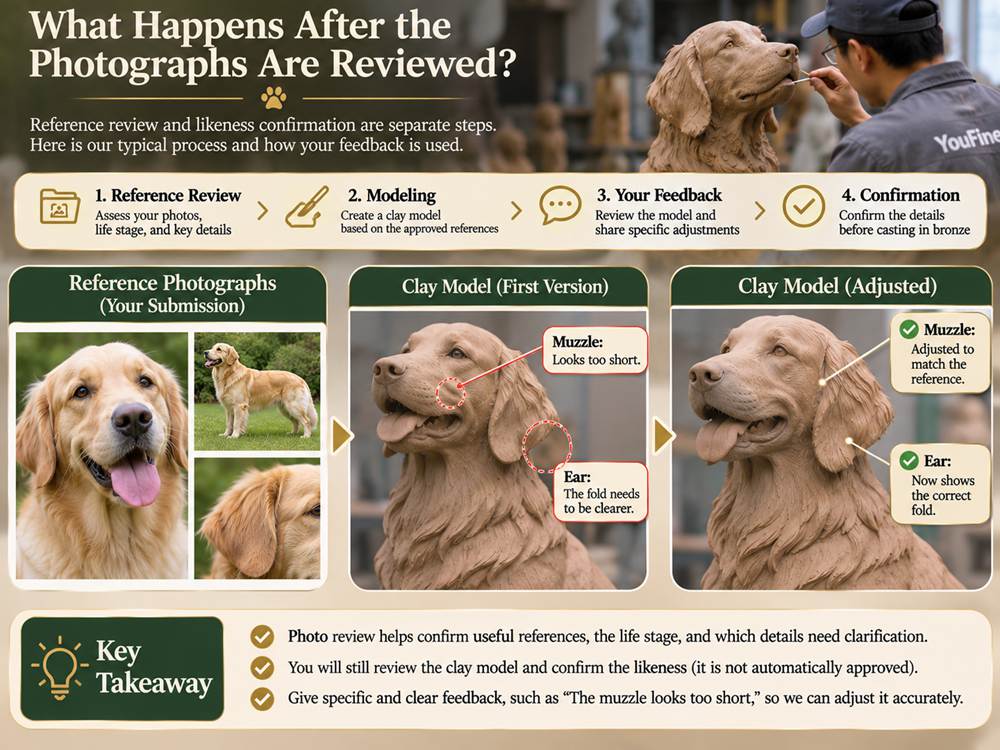
What Happens After the Photographs Are Reviewed?
I keep reference review and likeness confirmation separate.
Initial review concerns the materials you submit. It helps determine which photographs are useful, whether they represent a consistent life stage, and which features or pose details need clarification.
During modeling, your review of facial details and identifying features remains important. A model is the sculpted form used to develop the statue; it should not be treated as automatically approved because reference photographs were accepted.
I recommend making feedback specific. Rather than saying only “It does not look right,” identify the difference: “The muzzle looks too short compared with the side photograph,” or “The ear fold needs to match this close-up.”
The diagram above illustrates a feedback method, not a documented customer result. If I use actual customer photographs or model-feedback comparisons for explanation, the permitted scope of use should be confirmed first, with authorization and anonymization as appropriate.
Such comparisons can show what a photograph clarified and what required confirmation. They are not proof of the finished bronze statue’s likeness.
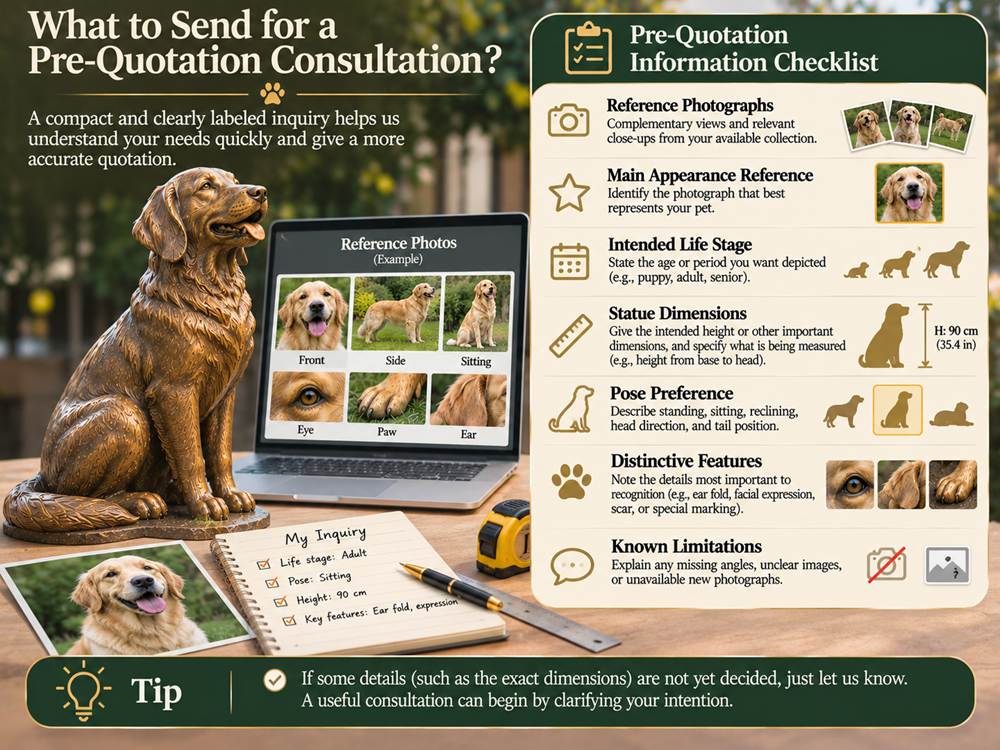
What Should You Send for a Pre-Quotation Consultation?
I recommend a compact, clearly labeled inquiry rather than a large collection without explanation.
This checklist covers the information most useful for starting the discussion.
| Information | What to Provide |
|---|---|
| Reference photographs | Complementary views and relevant close-ups from your available collection |
| Main appearance reference | Identify the photograph that best represents your pet |
| Intended life stage | State the age or period you want depicted |
| Statue dimensions | Give the intended height or other important dimensions, and specify what is being measured |
| Pose preference | Describe standing, sitting, reclining, head direction, and tail position |
| Distinctive features | Note the details most important to recognition |
| Known limitations | Explain missing angles, unclear images, or unavailable new photographs |
If dimensions are not decided, tell me that too. A useful consultation can begin by clarifying your intention, without treating every preliminary detail as final.
Frequently Asked Questions
1. How many photographs do I need for a custom bronze pet statue?
I recommend thinking in terms of coverage rather than a fixed number. Clear complementary views are more useful than many nearly identical images. Send what you have, and I can help identify what needs clarification during the initial consultation.
2. Can I start with only one photograph?
Yes, you can begin an inquiry with one photograph. I would explain that it may leave important questions about profile, body proportions, or hidden features. Starting a consultation does not establish that one image is sufficient for the intended statue.
3. Can I include photographs from different ages?
Yes, but I recommend labeling them. Choose the life stage the statue should represent and identify younger or older photographs as supplementary references.
4. Will clear photographs guarantee that the statue looks like my pet?
No. I treat photographs as references, not a likeness guarantee. Facial structure and identifying features still need your attention during model review, and that review should not be presented as proof of the finished result.
5. Should I send edited photographs or the original files?
I prefer original, unfiltered files where available because they preserve more reference information. If an edited image best communicates your preferred expression or appearance, include it separately and explain its purpose.
6. What if I have not decided on the statue’s size or pose?
I suggest sending your available photographs with a preliminary preference and noting what is undecided. Those open questions can then be addressed during the pre-quotation discussion rather than left implicit.
Aim for Clear References, Not More References
My main advice is to choose photographs that work together. Establish the intended life stage, separate personality images from shape references, and point out the features that make the pet recognizable to you.
Good preparation makes uncertainty easier to discuss. It does not remove the need for your confirmation of facial details and identifying features during modeling.
To begin a pre-quotation consultation with You Fine Art Sculpture, send your available reference photographs, intended statue dimensions, and pose preferences. Include a short note identifying the appearance you want represented and any missing information. I can then help clarify the references and the questions that need attention before the project moves forward.