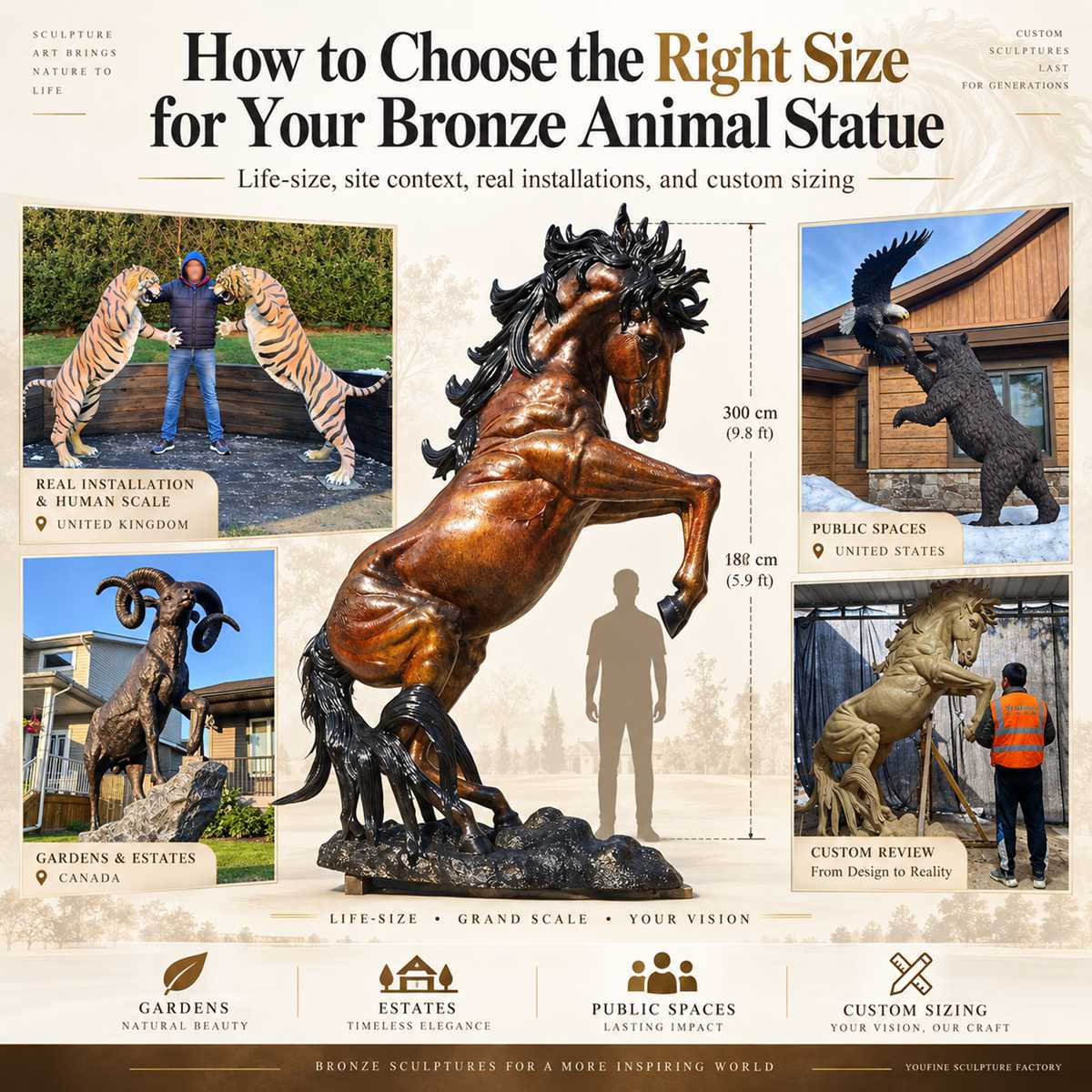
Choosing the size of a bronze animal statue is rarely as simple as picking “life-size.” A bear that looks powerful at the edge of a forested estate can feel oversized squeezed against a suburban porch. A pair of eagles perfectly scaled for a museum courtyard can disappear entirely in an open plaza. After four decades of casting animal sculptures for gardens, estates, campuses and civic spaces, our factory has learned that scale — more than pose or patina — is usually what separates a sculpture that feels inevitable in its setting from one that feels like an afterthought.
This guide walks through how we think about sizing bronze animal statues: what “life-size” actually means in foundry terms, how site type should drive your decision, typical dimension ranges by species, and how to read a scale reference before you commit to a casting.
What “Life-Size” Actually Means in Bronze Casting
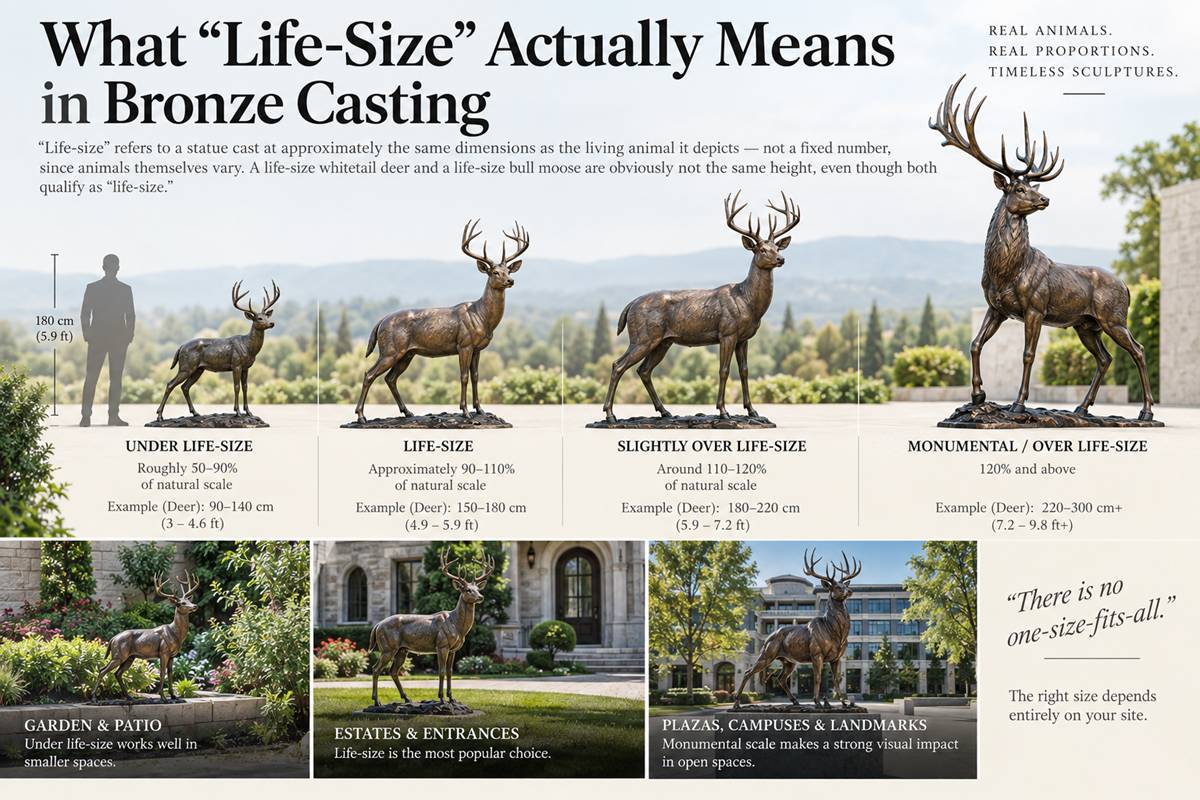
In the sculpture trade, “life-size” refers to a statue cast at approximately the same dimensions as the living animal it depicts — not a fixed number, since animals themselves vary. A life-size whitetail deer and a life-size bull moose are obviously not the same height, even though both qualify as “life-size.”
Foundries also work in three other common scale categories:
- Under life-size (roughly 50–90% of natural scale) — common for garden and patio settings where a full-scale animal would overwhelm the space
- Life-size (approximately 90–110% of natural scale) — the most requested category for estates, entrances and naturalistic landscaping
- Monumental / over life-size (120% and above) — used for public plazas, campus mascots, resort landmarks and civic commissions, where the sculpture needs to hold its own against buildings, distance and foot traffic
None of these categories is inherently “correct.” The right choice depends entirely on the site.
Sizing by Setting
Garden and Backyard Settings
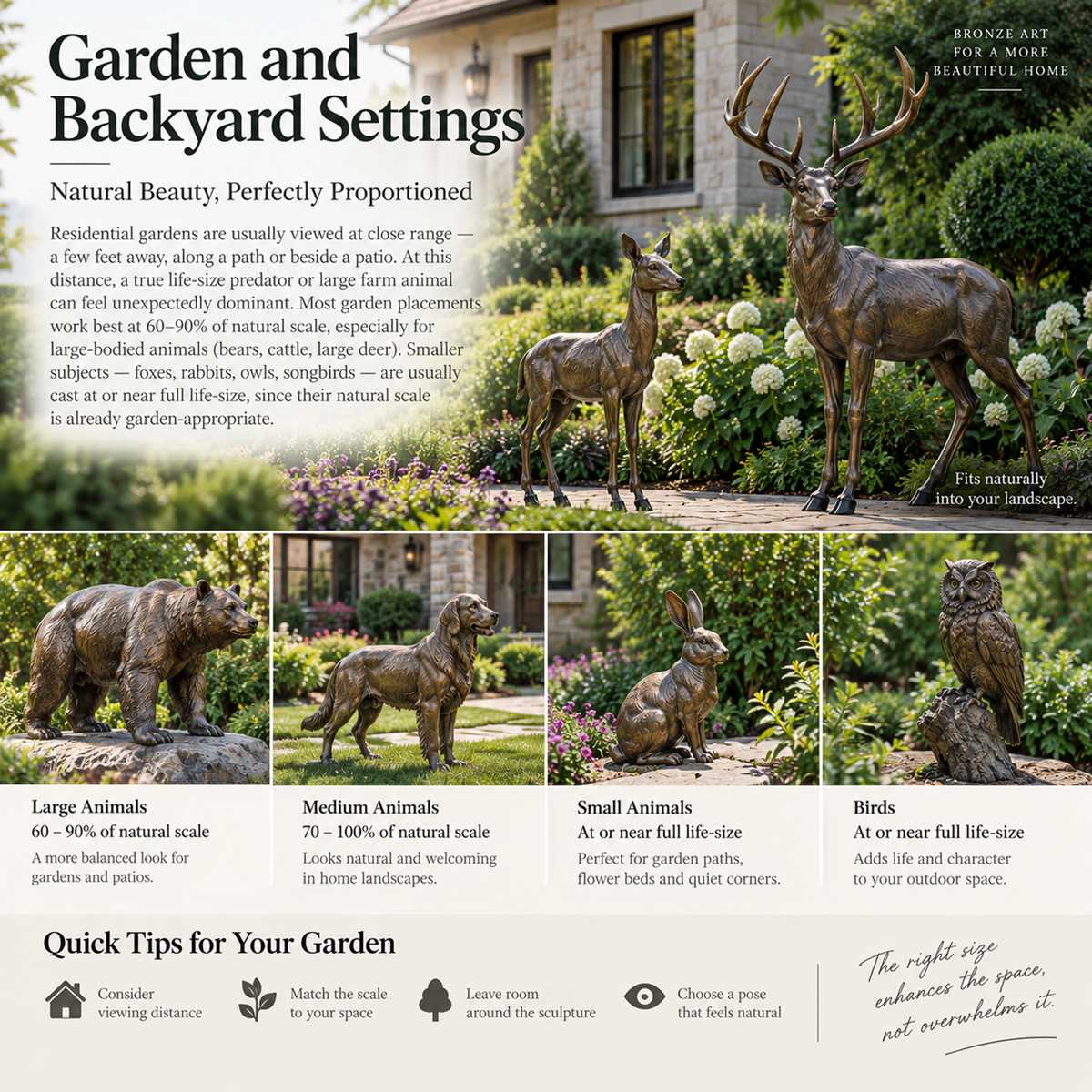
Residential gardens are usually viewed at close range — a few feet away, along a path or beside a patio. At this distance, a true life-size predator or large farm animal can feel unexpectedly dominant. Most garden placements work best at 60–90% of natural scale, especially for animals that are large-bodied to begin with (bears, cattle, large deer). Smaller subjects — foxes, rabbits, owls, songbirds — are usually cast at or near full life-size, since their natural scale is already garden-appropriate.
Estate Grounds and Private Entrances
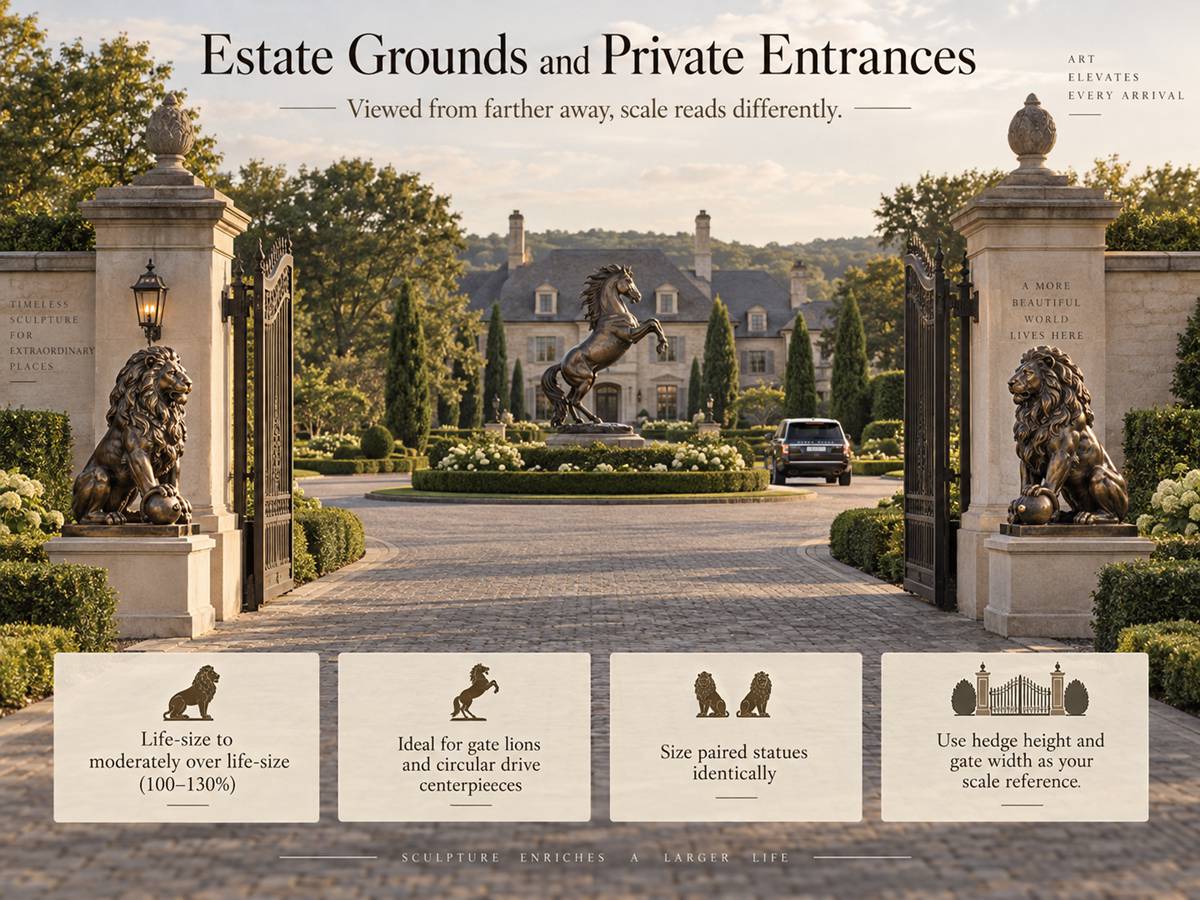
Estate driveways, lawns and gatehouses are viewed from farther away — often from a moving vehicle — which changes the perceived scale of a statue considerably. Life-size to moderately over life-size (100–130%) tends to read correctly here, particularly for statement pieces like guardian lions flanking a gate or a rearing bronze horse at the center of a circular drive. Paired statues are typically sized identically on both sides, with the surrounding landscaping (hedge height, gate width) used as the reference point rather than the house itself.
Public Spaces, Campuses and Resorts
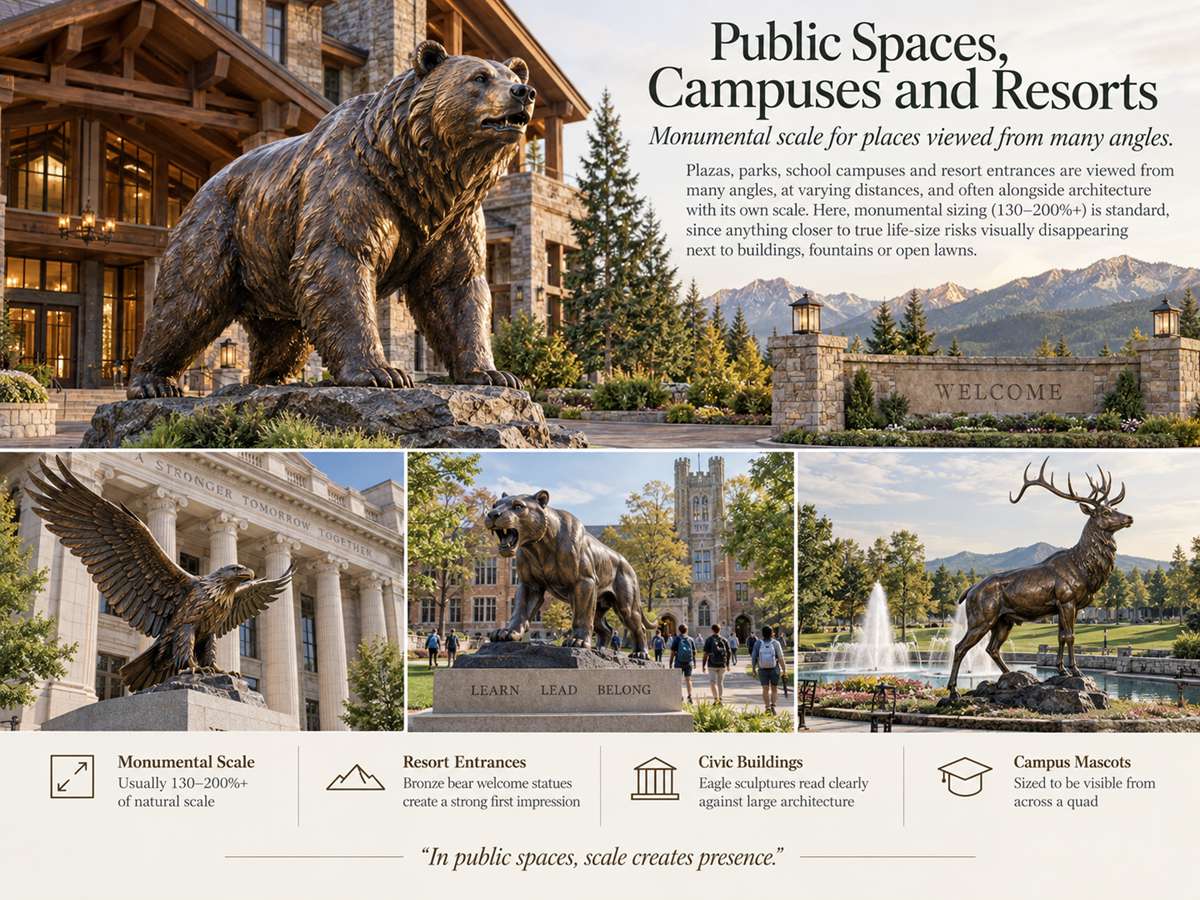
Plazas, parks, school campuses and resort entrances are viewed from many angles, at varying distances, and often alongside architecture with its own scale. Here, monumental sizing (130–200%+) is standard, since anything closer to true life-size risks visually disappearing next to buildings, fountains or open lawns. This is where we see the most demand for bronze bear welcome statues at resort entrances, eagle sculptures on civic buildings, and school mascot commissions sized to be visible from across a quad.
Typical Size Ranges by Animal
The ranges below reflect the sizing conversations that come up most often with buyers. Treat them as a starting point for discussion, not a fixed catalog spec — every commission is scaled to the specific site and reference the client provides.
| Animal | Typical life-size height | Common project range |
|---|---|---|
| Bronze bear (standing grizzly/black bear) | 6–7 ft (183–213 cm) | 3 ft to 9+ ft (91–274+ cm) |
| Bronze lion (standing, adult male) | 3.5–4 ft at shoulder (107–122 cm) | 2 ft to 6 ft (61–183 cm) for guardian pairs |
| Bronze horse (standing, full body) | 5.5–6 ft at head height (168–183 cm) | 3 ft to 10+ ft (91–305+ cm) for equestrian monuments |
| Bronze deer / elk (standing stag) | 4–6 ft at head height (122–183 cm), elk taller | 2.5 ft to 7 ft (76–213 cm) |
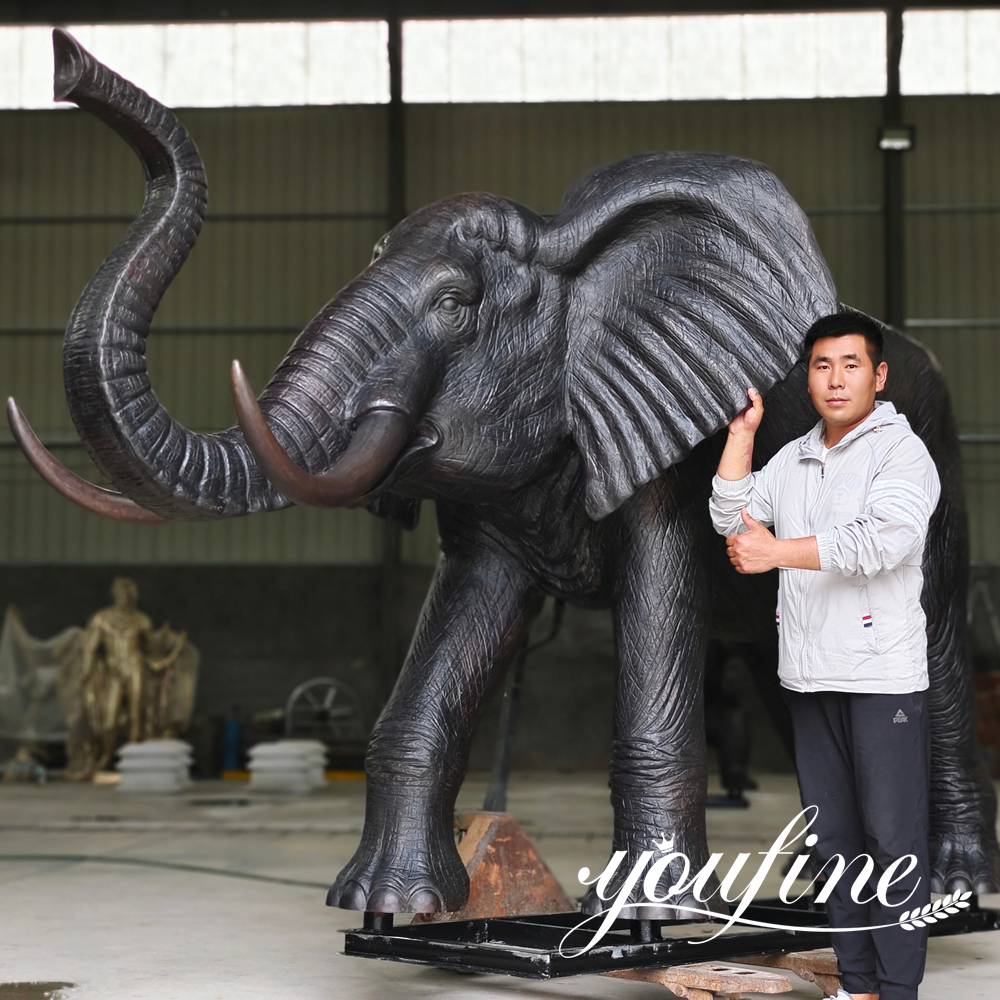
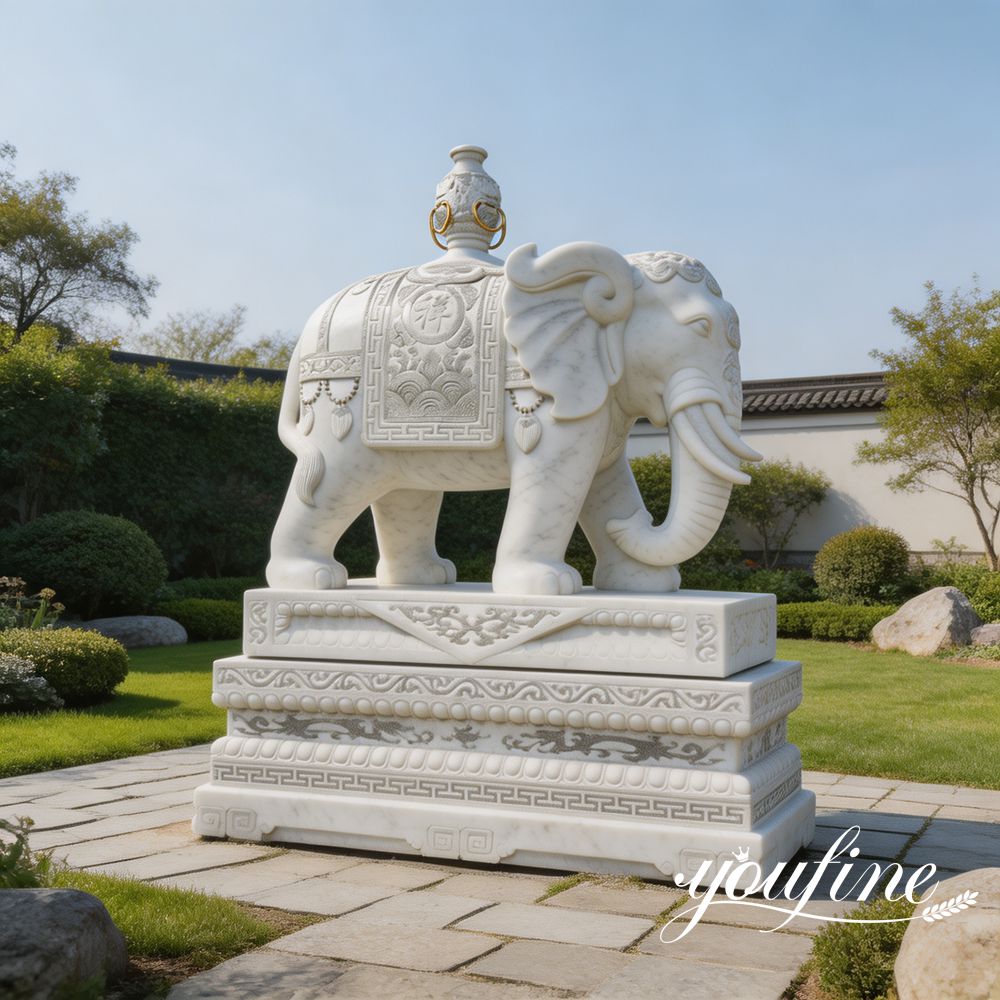
| Bronze elephant (adult, standing) | 9–11 ft at shoulder (274–335 cm) | Frequently reduced to 4–6 ft (122–183 cm) for garden use |
| Bronze eagle (perched, wings folded) | 2.5–3 ft (76–91 cm) | Up to monumental wall-mounted or plinth pieces over 6 ft (183 cm) |
Dual units matter here: inches and centimeters are worked into every quotation, since international buyers rarely default to the same unit.
Reading a Scale Comparison Before You Order
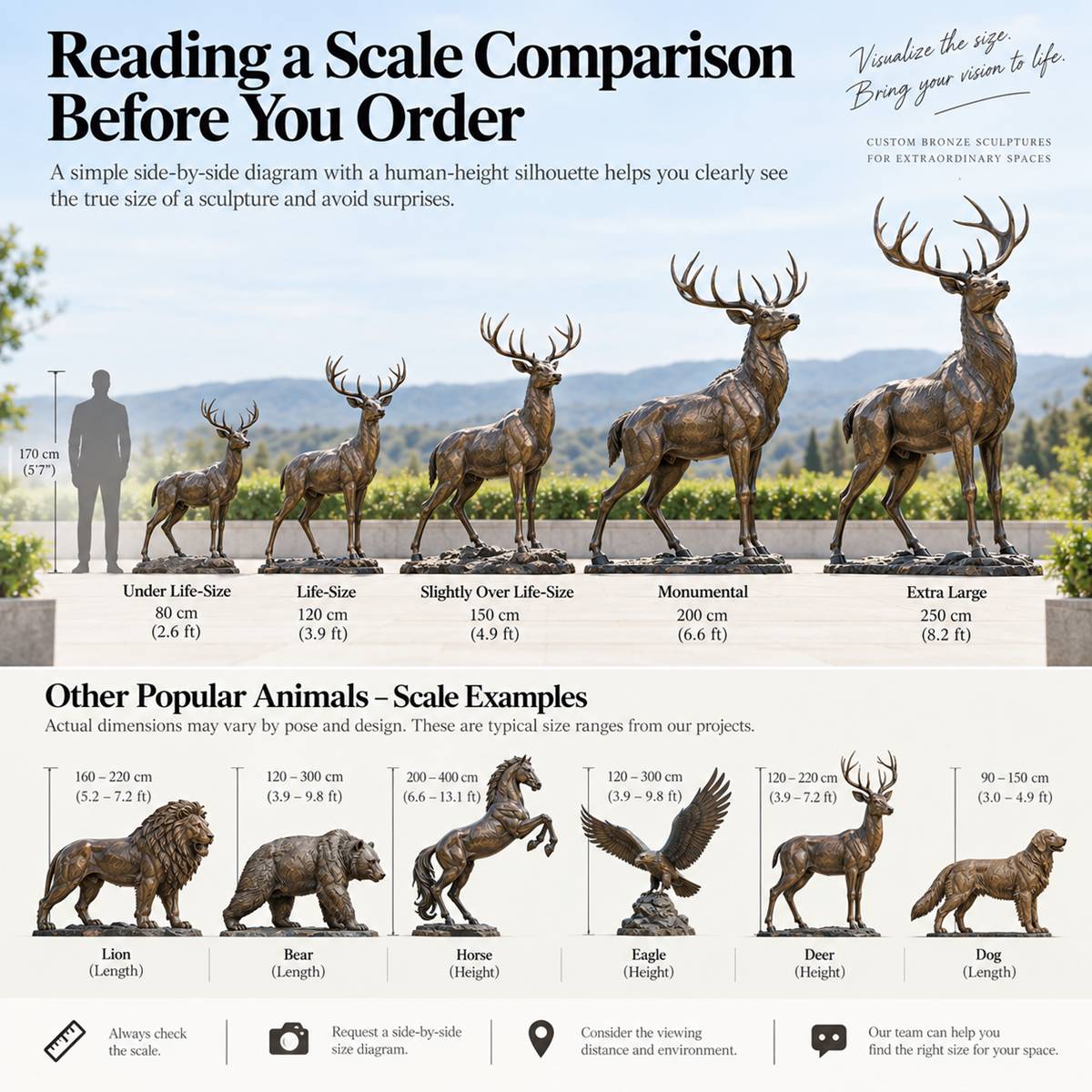
Because photographs of finished sculptures rarely include a size reference, we recommend viewing any proposed statue alongside a human-height silhouette (typically 5’7″/170 cm) before approving a design. A simple side-by-side diagram — sculpture outline next to an average adult figure — resolves most sizing misunderstandings faster than dimensions alone, especially for buyers who haven’t stood next to a monumental bronze in person. If your design brief doesn’t include one, it’s worth asking your foundry for it.
[Suggested placement: scale comparison diagram — sculpture silhouette beside a human figure, with height marked in ft/in and cm]
What Real Installations Show About Scale
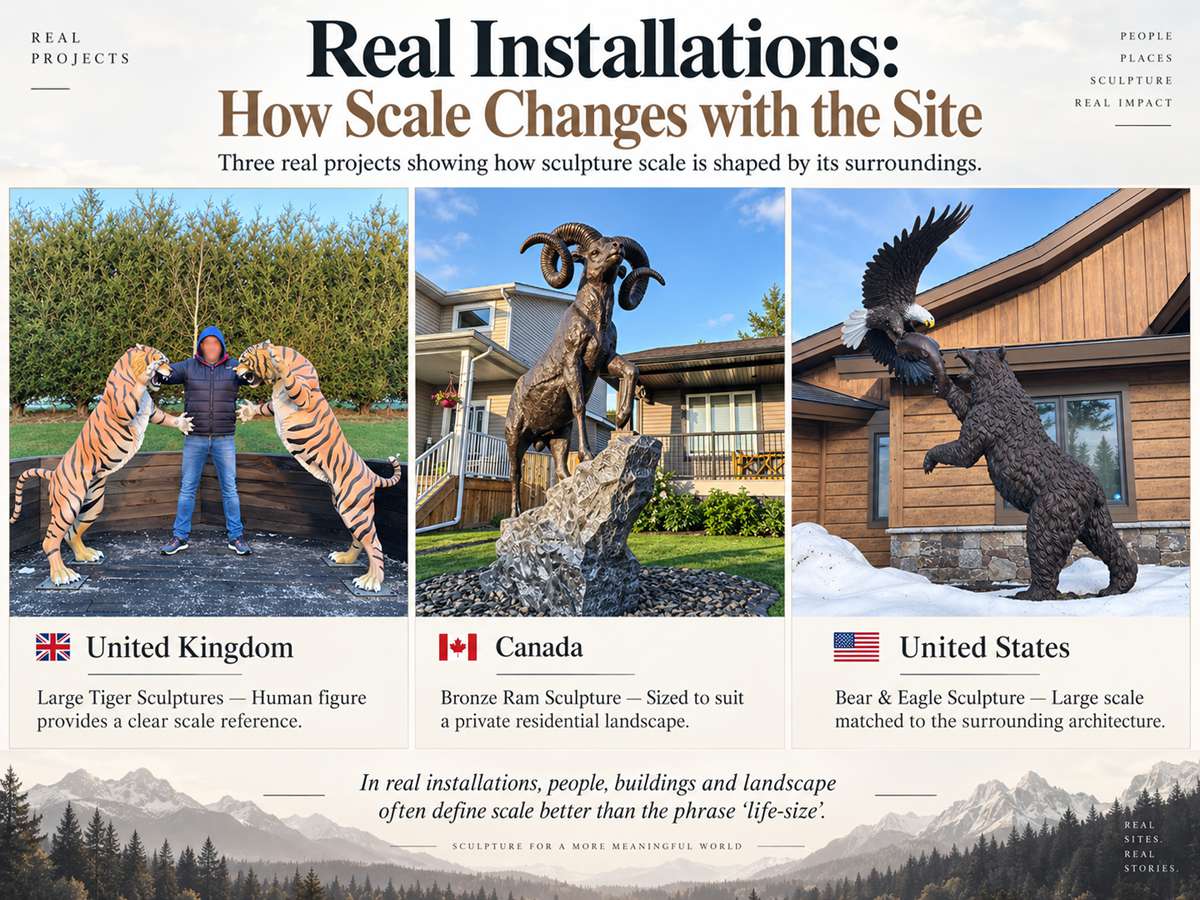
Three recent placements illustrate how differently the same “life-size” label can play out depending on site:
- A bronze elk in a U.S. landscape setting, positioned among mature trees on open acreage, was sized toward the upper end of natural elk proportions so it would read clearly from the house and driveway rather than being absorbed by the surrounding tree line.
- A bronze eagle delivered to a client in Germany was scaled for a more architectural, close-viewing placement, where a monumental size would have overwhelmed the structure it was paired with.
- A pair of white marble lions installed at a residential entrance in Australia were matched in scale to the gate piers flanking them — the piers, not the house, were the controlling dimension for sizing the pair.
(Photos and full case details: Client Installations)
The pattern across all three: the surrounding structure — tree line, building facade, or gate pier — decided the final scale far more than a generic “life-size” target did.
Custom Sizing Is the Norm, Not the Exception
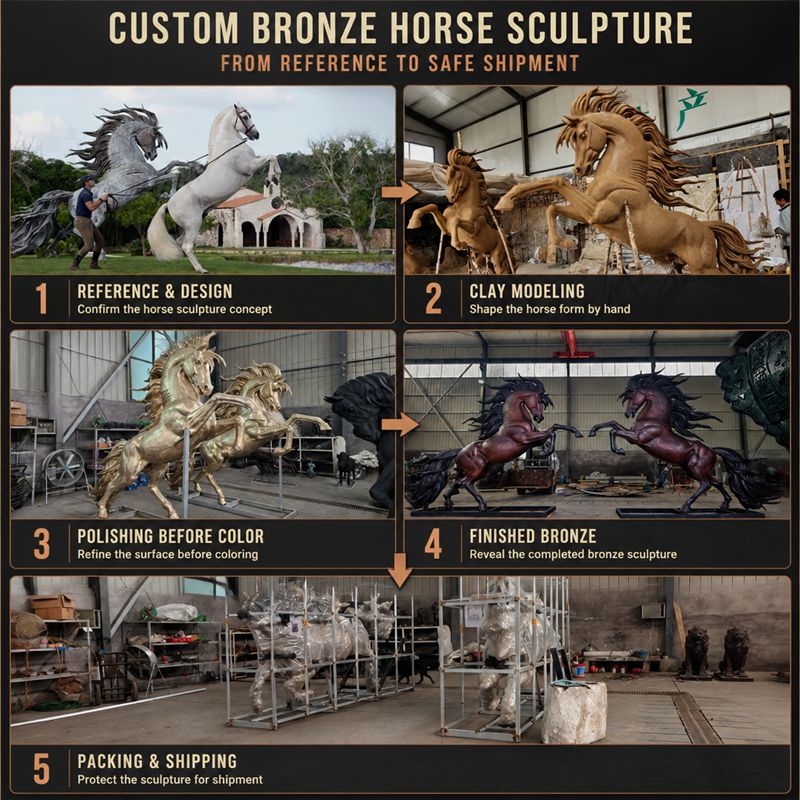
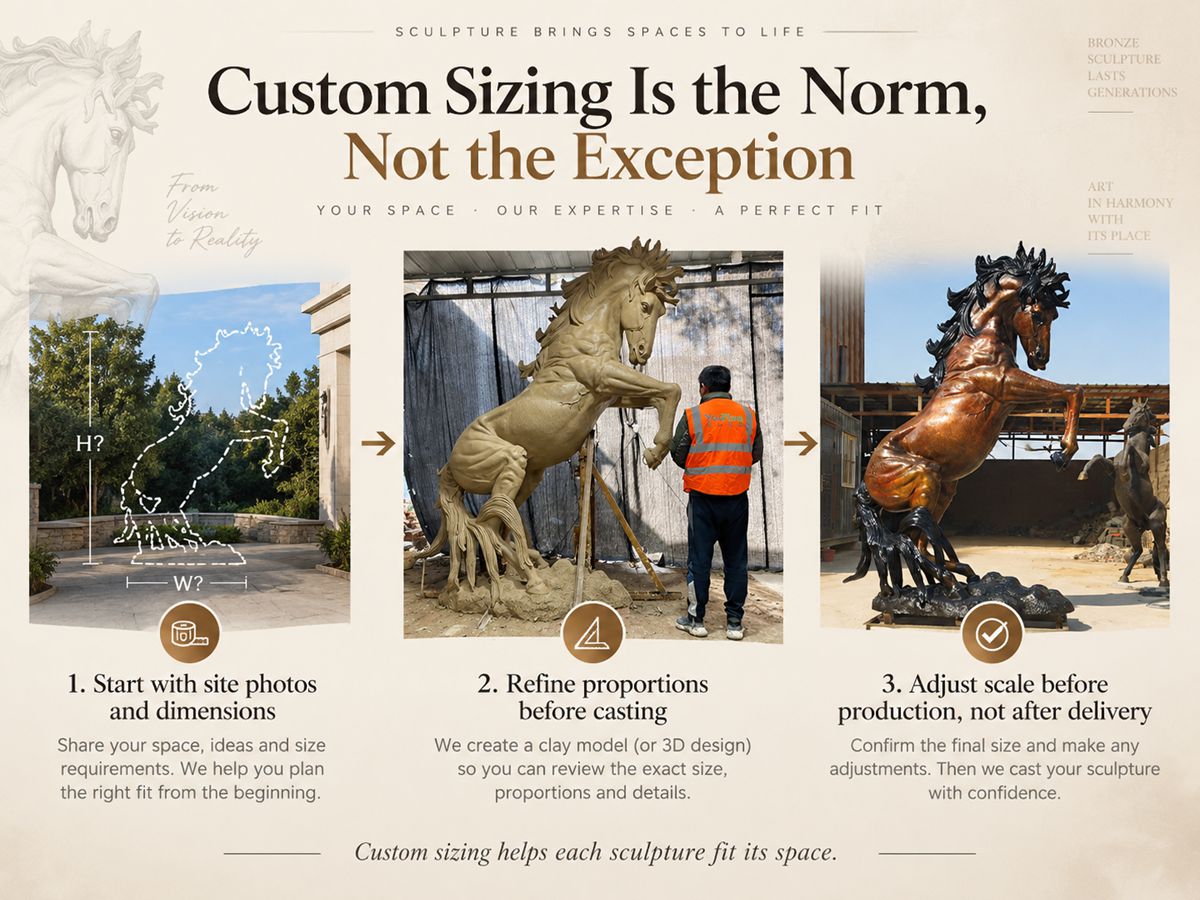
Because bronze animal statues are modeled and cast to order, sizing isn’t limited to a fixed set of options. Our process starts with the site: photos, dimensions and the visual direction the client has in mind. From there, proportions are refined through a clay model or design review before any bronze is poured, so scale can be adjusted before production rather than after delivery. This is standard for both single statues and matched pairs, where consistent proportions across two or more castings matter as much as the size of any one piece.
Frequently Asked Questions
Is “life-size” always the right choice for a garden? Not usually. For large-bodied animals, most garden placements read better at 60–90% of natural scale. True life-size or larger is more common for estate entrances and public spaces.
How do I know what size will actually look right on my site? Send photos or a simple site sketch with known dimensions — a doorway, fence line or existing planting gives a reliable scale reference your foundry can design against.
Can a design be adjusted in size after I’ve seen a reference photo? Yes. Since each sculpture is modeled to order, proportions can be scaled up or down from a reference design before production begins.
Does size affect shipping and installation significantly? Yes — weight increases faster than height as a design scales up, which affects crating, freight method and the base or foundation needed on-site. This is worth confirming early if you’re working within a fixed budget or delivery timeline.
Do matched pairs need to be identical in size? For symmetrical placements (gate lions, paired eagles), yes — pairs are cast from the same scale specification to keep proportions consistent on both sides.
Have a specific site in mind? Share a few photos and rough dimensions and we can talk through what scale will actually work before any design work begins.